
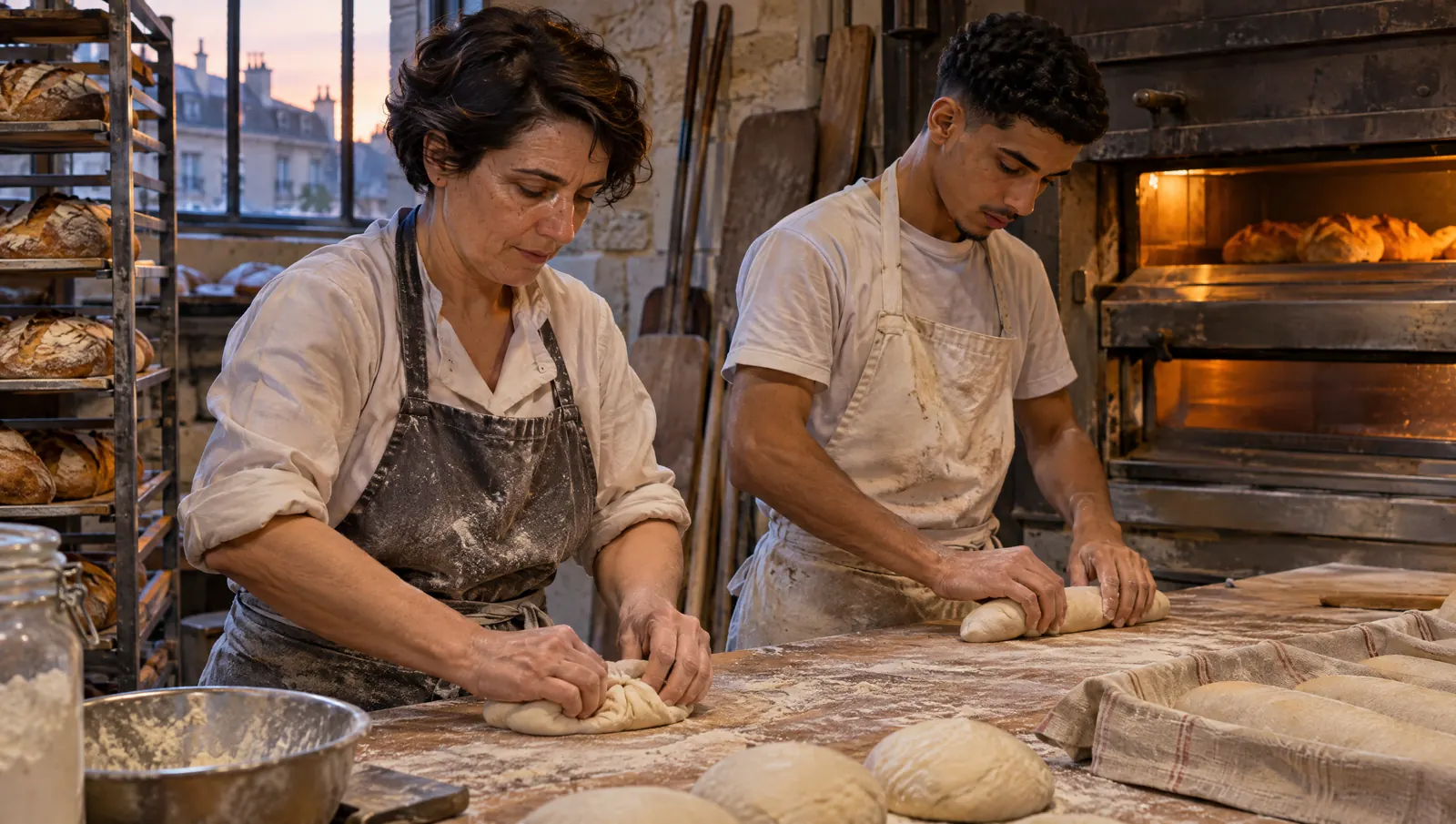
In hands-on jobs, the biggest change ahead is the route information takes to the people doing the work. Procedures, the next task and routine checks will come to the workstation instead of being hunted down in a binder. When hands are full, a spoken question can replace the screen, and managers will spot drift sooner. Shaping, tasting, welcoming and deciding will stay with people, provided the tool fits their station and the rules of use are written down before it arrives.
Tuesday, 5:40 a.m., in a bakehouse
The oven is heating up. Estelle, the baker, is shaping traditional baguettes. Next to her, Lucien, an apprentice since September, is shaping too, a little slower. His dough pieces are still uneven. Estelle does not point him to a screen: she takes his hands and shows him the pressure of the thumb, the move that seals without crushing.
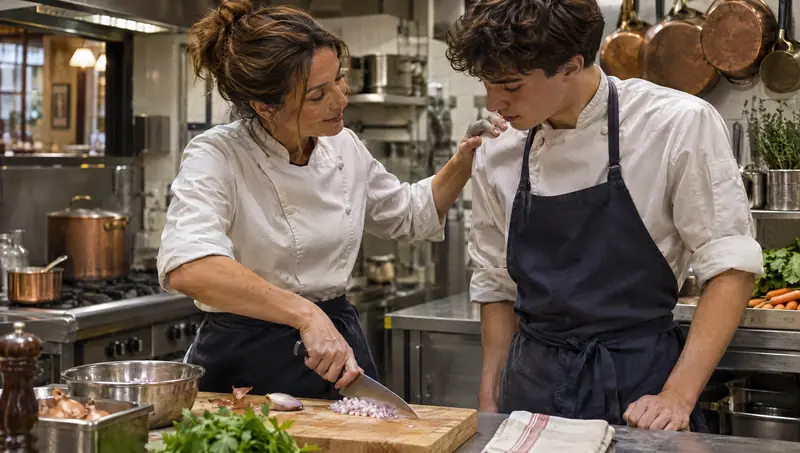
At 6:10, Lucien has a question that has nothing to do with shaping: the core temperature for cooling today's custards, and who signs off the reading when Estelle is at the oven. Yesterday, he would have waited until she was free, or guessed. This morning, the bakery's approved sheet is within reach, and the reading gets done on time.
Both scenes happen in the same room, thirty minutes apart. Nobody will be shaping baguettes for Estelle ten years from now. The way Lucien finds the right sheet, on the other hand, is already shifting.
(Scene and characters are fictional.)
What will not change
Craft
Filleting a sea bass or plating at the pass is learned by doing it a hundred times, with someone who knows watching. A tool can remind you of the steps. Estelle's thumb on Lucien's hand has no equivalent on a sheet.
Taste
The line cook who dips a spoon in the beurre blanc and adds a squeeze of lemon is doing work no assistant will do. Sensing that a dough has overproofed, judging a bake by eye and touch: that is where the craft lives.
Hospitality
The counter assistant who recognizes a regular and sets aside a well-baked baguette for them needs no tool at all. That is why we recommend keeping voice to back-of-house stations (kitchen, bakehouse, stockroom) and not talking to an assistant in front of customers. It is a usage principle we advise businesses to adopt, not a technical limit of the device.
Decisions
A case of cream delivered at 7 °C: refuse it or keep it? Is the new hire ready to close alone on Saturday? The tool can pull up the receiving sheet or the closings already done. The answer belongs to the person in charge. At Tsuno we put it this way: Tsuno brings the facts together, people decide. We go further in the place of people when the tool has the answer.
What the research says, without crystal balls
Few predictions about the future of work can be checked. Here are two solid sources, and what they actually say.
The OECD, in its Employment Outlook 2023 (press release of July 11, 2023), estimates that, taking the effect of AI into account, occupations classified as at highest risk of automation account for about 27% of employment. A risk is not an announced job cut. The same publication reports a survey of workers and companies in finance and manufacturing in seven countries: workers and employers say AI can reduce tedious and dangerous tasks, but three in five workers worry about losing their job to AI within ten years, three in four say AI has increased their pace of work, and more than half are concerned about privacy.
The International Labour Organization, in its Working Paper 140 published in May 2025 ("Generative AI and Jobs: A Refined Global Index of Occupational Exposure"), estimates that one in four workers worldwide is in an occupation with some exposure to generative AI, and that 3.3% of global employment falls into the highest exposure category. Its conclusion: most occupations consist of tasks that require human input, so transforming jobs is the most likely impact.
For a baker or a cook, these figures shift the question. It becomes: what will move around my craft, and on what terms? The three concerns the OECD picked up (pace, privacy, jobs) are also what you hear in the locker room the day a new tool shows up.
What will change in kitchens, bakehouses and stockrooms
Information comes to the workstation
Today, a procedure lives in a binder in the office, in a group chat or in a senior colleague's head. Tomorrow, it comes to the person who needs it, at the moment of the task: the opening checklist, the next task, the cleaning sheet for the slicer. The gain is daily: fewer repeated questions, fewer interruptions for the manager. We go through this station by station in 10 changes in the restaurant of tomorrow.
Voice where screens get in the way
The dishwasher with both arms in the sink, the baker with floury hands, the person receiving three boxes at once: for them, touching a screen is a nuisance, sometimes a hygiene lapse. A question asked out loud, with a short answer, can save the trip to the office. Nobody should be made to speak, though, and use should stay back of house, as we advise above. We go into these conditions in what voice changes for people who work on their feet.
Managers anticipate instead of chasing
Every other Sunday, the closing checklist comes back incomplete, and the manager only finds out at the next inspection. AI built for managers can bring dated facts together (a closing checklist often incomplete on Sundays, an incident that keeps coming back, an action never closed) and help them see sooner what deserves their attention. It judges no one and decides nothing. We described this in AI for frontline managers: analyse, advise, reassure. Big logistics players are moving in this direction, with choices a restaurant does not have to copy as they are: see what Amazon does with AI for frontline teams, and what a restaurant can learn.
Passing on skills gets organized
Know-how walks out the door with people. Tomorrow, skills transfer can be organized without being watered down: a pathway per station, a technique observed in real conditions, a skill signed off and dated by a manager. That is the spirit of AFEST, the French framework for workplace-based training, and of Tsuno Compétences. A workstation assistant does not train people in place of an experienced colleague; it reminds them of a step when that colleague is not around. We explain how the two fit in learning on the job: AFEST and a workstation assistant.
Tools start talking to each other
Tomorrow, general-purpose assistants will plug into a company's tools, with rules. With Tsuno, you can already query your data from your usual AI assistant (ChatGPT, Claude, Mistral), with the same permissions as in Tsuno. The mechanism is explained in MCP: connecting your AI to your business, explained for frontline trades.
The real risks, and why they need naming
A team that only hears about benefits gets suspicious, often with good reason. Three risks deserve to be put on the table at the very first meeting.
Surveillance
A tool that knows what was done can quickly become a tool that tracks who did it, how fast and with what hesitation. European lawmakers saw this coming: the EU AI Act (Regulation (EU) 2024/1689) lists as high-risk, in its Annex III, systems intended to allocate tasks based on individual behaviour or to monitor and evaluate the performance and behaviour of people at work. And its Article 5 has banned, since February 2, 2025, systems that infer emotions in the workplace, except for medical or safety reasons. On this slide, read why management software can quickly feel like surveillance.
Deskilling
If the tool dictates every move without ever explaining why, people carry out steps without understanding them. They become dependent on the tool, and the craft gets thinner. This is not inevitable: it depends on how the tool is connected to skills transfer. We cover it in will AI deskill hands-on jobs?.
Pace
Three minutes saved looking for a sheet can go into cleaning the slicer properly, or into squeezing one more task in before service. In the OECD survey above, three in four workers say AI has sped up their pace. In a kitchen, where the rush is already hard, that is the drift to watch for.
The safeguards that make a tool acceptable
A tool the team suspects of watching them ends up unplugged or worked around, however useful it is. So the trust rules get settled before rollout. Here are the ones we consider essential, and that Tsuno applies.
- The tool acts within the person's permissions. San only sees and does what that person can already see and do in Tsuno.
- Nothing runs without confirmation. San prepares and summarizes, the person confirms, and it is logged.
- No one is judged by the machine. The AI does not score an employee on the manager's behalf. Tsuno does show a monthly leaderboard in the app to keep teams engaged: it counts points earned through training, punctuality and completed tasks. It is never passed to the assistant, and San assesses no one.
- No emotions are analyzed. Not stress, not fatigue, not mood.
- Sensitive data is not recorded. Tsuno refuses to record an employee's health, pregnancy, disability, religion or opinions (GDPR, Article 9) and offers to log dated, observed facts instead.
- Some actions stay out of the AI's reach: payroll, invoicing, permanent deletion and legal acts.
- Employee representatives are involved. In France, companies with at least 50 employees must inform and consult the works council (CSE) before introducing tools that can monitor activity (French Labour Code, Article L2312-38). See should you consult employee representatives before using a voice assistant?.
All our commitments are on the Trust and data page, and San's limits are listed in what San never does.
What changes, what stays, what protects
| Area | What changes | What stays human | Safeguard |
|---|---|---|---|
| Information | It comes to the workstation, at the moment of the task | Knowing when the rule does not apply | Sheets approved and dated by the business |
| Interface | Voice when hands are full | The choice to speak or not | Optional voice, recommended back of house |
| Management | Facts brought together sooner | The decision, the review, the trust | Dated work facts, never a score on a person |
| Skills | Pathways per station, tracking | The technique shown, taste, standards | Skills signed off by a manager on the job |
| Pace | Less searching, fewer interruptions | Time to do it right | No timing of individuals |
| Data | Tools connect to each other | Who sees what, who decides | The person's permissions, two steps, logs |
Technology should adapt, not the other way round
For years, kitchens have been handed software designed for offices: double entry, long passwords, screens that ignore gloved fingers. The chef would end up typing in, at night, the readings scribbled in marker on a piece of cardboard. A frontline tool should use kitchen words and fit into the few seconds you have between two tickets. We turned this into a manifesto: technology should adapt to people who work, not the other way round.
Adopting AI without losing the craft
In most places the tool will arrive one way or another. What is still open is how: one station and one use to begin with, rules written before the first trial, the views of the people who will do the work, and the freedom to stop what does not help. The method is in the tool, but how? Adopting AI without losing the craft.
That is also how we work. Tsuno was born at Kajirō Sushi, the founder's restaurant group: it was built in a kitchen and is used there every day. We test each use of San in real conditions before presenting it as available, and we explain why in why we test in the kitchen before we sell.
Beyond the kitchen
The same questions come up wherever people work on their feet: in the bakehouse and the shop, in service businesses, in wineries and vineyards, in cultural venues that welcome the public. The stations differ, the logic holds. We go through these trades in San beyond restaurants: bakeries, services, vineyards, culture, and each has its own page: bakeries, services, vineyards, cultural venues.
Common mistakes
- Believing the future of work is decided in offices. The uses that stick are the ones frontline teams adopt on their own.
- Buying the tool before writing the rules. A team that does not know what the tool will not do imagines the worst.
- Measuring success by time saved alone. A gain that turns into extra pace wears the team down.
- Replacing skills transfer with the tool. A step reminder is not worth a technique shown in person.
- Promising what does not exist yet. Teams test, and a broken promise costs more than an admitted limit.
What to measure
- How often the manager is interrupted for a procedure question, over one week, before and after.
- Voluntary use of the tool per station after one month. A tool that is imposed and worked around does not count.
- How long it takes a new hire to run a station alone, signed off by a manager, and what helped.
Where Tsuno and San fit in
Tsuno is the work tool for frontline teams: procedures, tasks, checklists, routine checks, equipment, scheduling, training. Tsuno San is its intelligent voice assistant, connected to that environment. It acts within the person's permissions, prepares actions and waits for their confirmation. San Voice, the voice interaction, is available as a demo; San Audio (hands-free) and San 360 (a broader vision of operational support) are being explored and tested, and we do not present them as shipped. The details are on the Tsuno San page. For skills transfer, Tsuno Compétences organizes pathways and workplace-based training. Tsuno San and Tsuno Compétences are Sirha Innovation Awards 2027 candidates.
If you are looking for a tool that decides for your teams or measures their output minute by minute, Tsuno is not built for that.
Every article on this topic
This guide is the entry point to the topic. The 19 articles that go deeper are grouped below by use.
What is already changing
- 10 changes in the restaurant of tomorrow: ten changes already under way in restaurants, each with what can go wrong.
- What Amazon does with AI for its frontline teams, and what a restaurant can learn: what Amazon does for its managers and drivers, and what a restaurant can borrow without timing anyone.
- Conversational assistant or job assistant: where is the line?: the line between an assistant that answers anyone and one that knows your workplace.
- Restaurant staff turnover: which French figures to use (and which to throw out): which French sources to quote on turnover, which to drop, and how to work out your own.
- A work assistant for bakeries, from the bakehouse to the shop: what a work assistant brings from the bakehouse at night to the counter in the morning.
Voice and equipment at the station
- Why talk to your tools when your hands are full: the stations and moments where talking to a tool really helps, and those where the screen stays better.
- What voice changes for people who work on their feet: the trips and the reading barriers voice removes, and its limits.
- Headset, earpiece, tablet: what really works in a kitchen: what works in a kitchen between a wall tablet, a phone, an earpiece and a closed headset.
- Eight hours wearing equipment: comfort and fatigue: heat, sweat, sore ears: the wearing rules for a whole shift.
- 5 reasons to adopt a voice assistant, and 5 reasons not to: the situations where a voice assistant helps and those where it disappoints, plainly.
The place of people and the craft
- The place of people when the tool has the answer: what the chef keeps when the tool answers the how: the why, taste, example, decisions.
- Will AI deskill hands-on jobs?: where the deskilling risk comes from and how design and management prevent it.
- Passing on a skill: what no AI will replace: the part of a skill that is shown and corrected by hand, and how AI frees up the mentor.
- Technology should adapt to people who work, not the other way round: the three requirements a field tool must meet so the team does not go back to paper.
Adopting without losing the team
- The tool, but how? Adopting AI without losing the craft: the seven-step approach, from a real problem to the right to stop.
- Why teams reject new tools: the nine reasons teams reject a tool and what defuses each one.
- Old hands: the first allies of a knowledge-sharing tool: how to make the old hand the author and the referent rather than the pupil.
- The mentor and the assistant: who does what in training: the split of roles between mentor and assistant to announce on day one.
- Learning on the job: AFEST and a workstation assistant: how AFEST turns the workstation into a place of training and where an assistant can help.
The four other reference guides
- Tsuno San: the work companion for frontline teams: what the team assistant is, what it does and its safeguards.
- AI for frontline managers: analyse, advise, reassure: the four useful roles of AI for a frontline manager.
- MCP: connecting your AI to your business, explained for frontline trades: connecting your AI assistant to your tools without opening doors.
- AI, voice and privacy at work: the guide: the legal and design rules for an acceptable voice AI at work.
Key takeaways
In hands-on jobs, AI will mostly change the route information takes to the workstation; craft, taste and hospitality keep their value. Teams will take it up if the tool fits their working day and its rules of use are written before the first trial.
Frequently asked questions
Will AI replace cooks, bakers or dishwashers?
The available research mostly points to transformation. In May 2025, the International Labour Organization estimated that one in four workers worldwide is in an occupation with some exposure to generative AI, and that transforming jobs is the most likely impact, because most occupations include tasks that require human input. Craft, taste and hospitality remain human.
What will actually change for kitchen and bakery teams?
Mostly the way information moves. The procedure, the next task or the checklist comes to the workstation instead of being looked up in a binder. Voice helps when hands are full. Managers see drift earlier. And passing on skills can be better organized.
Does AI at work increase the pace of work?
It can. In the OECD survey published with the Employment Outlook 2023, covering workers in finance and manufacturing in seven countries, three in four workers said AI had increased their pace of work. That is why a frontline tool should serve the work, not time the people doing it.
How do you stop an AI assistant from becoming a surveillance tool?
With written, verifiable rules: the tool acts within the person's permissions, does nothing without their confirmation, never scores or judges anyone and does not analyze emotions, which the EU AI Act has banned in the workplace since February 2, 2025. In France, companies with at least 50 employees must consult the works council before introducing tools that can monitor activity.
Could AI make workers lose their craft?
The risk is real if the tool dictates every move without ever explaining it. The safeguard is to connect the tool to skills transfer: a procedure that says why, a technique shown by an experienced colleague, a skill signed off by a manager on the job.
Where does Tsuno San stand today?
San Voice, the voice interaction, is available as a demo. San Audio, the hands-free experience, and San 360, a broader view of operational support, are being explored and tested. San acts within the person's permissions and nothing runs without their confirmation.
Keep reading
Future of work
A companion, not a supervisor
A good frontline tool helps the person doing the work first: answer, remind, report. Once it makes numbers about them for someone else, it turns into control.

Future of work
Conversational assistant or job assistant: where is the line?
A conversational assistant answers anyone with no context; a job assistant knows your location, acts within your permissions and asks for confirmation.

Future of work
Our red lines: the ethics of AI at work
Workplace AI is judged by what it refuses to do, even when a big customer asks. Our principles, four real dilemmas, and what we choose not to sell.