
In October 2025, Amazon publicly presented AI tools to help its operations managers anticipate problems and its delivery drivers get information without putting the packages down. A restaurant can keep the core of it: help the manager see what is coming and get the information to the station, which cuts down on repeated questions along the way. What it should not copy is documented too, by the French data protection authority and by investigations in the United States: fine-grained tracking of each worker's productivity, continuous monitoring and a pace set by an algorithm.
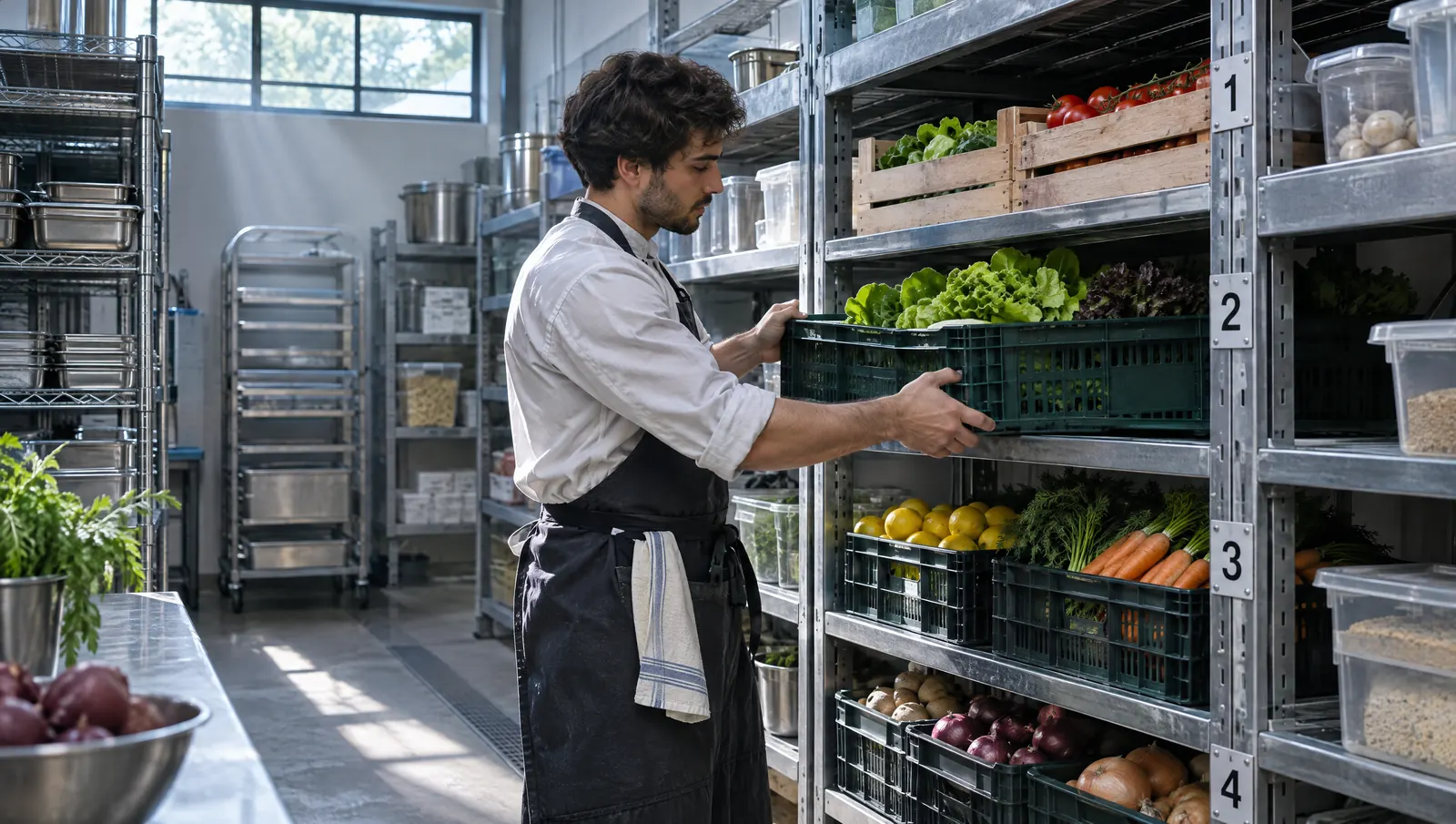
Saturday, 6:50 a.m., in the storeroom
The delivery came in early. Sophie, the general manager, checks the delivery slip while Laurent stacks crates on the numbered shelves. "Does the cream go on 4 or 6?" Second question in five minutes. Sophie answers without looking up. She is thinking about lunch: two people out, a party of thirty, and a line cook who has never worked the cold station.
That morning, Sophie needs neither a robot nor a screen timing Laurent. She needs to know at 7 a.m. what will go wrong at noon, and she needs Laurent to find where the cream goes on his own.
(Scene and characters are fictional.)
What Amazon has announced for its frontline teams
The facts below come from Amazon's own posts on aboutamazon.com and from major media, with their dates.
An AI agent for operations managers
On October 22, 2025, at its "Delivering the Future" event, Amazon presented Project Eluna, described as an agentic AI system for its operations managers. According to Amazon, these managers watch dozens of dashboards while dealing with breakdowns and moving people around. Eluna combines the site's historical and real-time data to anticipate problems and suggest data-backed actions. A manager can ask it, for example, where to shift people to avoid a bottleneck. Amazon announced a first pilot at a fulfillment center in Tennessee during the 2025 holiday season, starting with sortation. We found no public results from that pilot as of this article.
Smart glasses for delivery drivers
The same day, Amazon presented smart glasses for its delivery drivers. They show which package to scan, walking directions to the door and proof of delivery, and flag hazards such as a dog or an uneven path, without the driver taking out a phone. On that page, updated in 2026, Amazon states that wearing the glasses is optional and that the device has a switch that turns the camera off.
A robot announced, then shelved
Also on October 22, 2025, Amazon presented Blue Jay, a multi-arm robotic system meant to reduce repetitive reaching and lifting. On February 18, 2026, TechCrunch reported that the project had been halted. Amazon's page carries an update dated February 25, 2026: the company no longer uses Blue Jay in operations, and its technology will go into other programs. Announcing a robot does not mean it ever went into service.
What regulators and investigators have found
The CNIL and France's highest administrative court
In a decision dated December 27, 2023 (SAN-2023-021), published January 23, 2024, the CNIL, France's data protection authority, fined Amazon France Logistique 32 million euros. It targeted in particular three indicators drawn from workers' handheld scanners: one flagging an item stowed less than 1.25 seconds after the previous one, scanner idle periods of more than ten consecutive minutes, and idle time at the start and end of the day or just before and after breaks. This data, along with other indicators, was kept for 31 days for every employee and temp worker. The CNIL also found that staff were not properly informed and that CCTV was poorly managed.
The Conseil d'État, France's highest administrative court (decision no. 492830, December 23, 2025), cut the fine to 15 million euros. It ruled that processing those three indicators in real time did rest on the company's legitimate interest, given the constraints of a warehouse. But it confirmed that keeping all the indicators, without distinction, for 31 days breached the GDPR's data minimization principle; the findings on informing staff and temp workers and on CCTV security were not challenged. The lesson is nuanced and useful: flagging an anomaly in the flow as it happens can be justified; keeping a month of detail on each person's activity cannot.
The US Senate and OSHA
In December 2024, the Democratic majority staff of the US Senate HELP Committee, then chaired by Bernie Sanders, published an investigative report stating that Amazon warehouses recorded about 30% more injuries in 2023 than the industry average, and that internal recommendations to relax pace targets had been turned down. Amazon rejected the report's conclusions.
On December 19, 2024, OSHA, the federal workplace safety agency, announced a corporate-wide settlement with Amazon on ergonomic hazards in its warehouses: annual risk assessments, training and site ergonomics leads, for a two-year term, with a 145,000 dollar penalty. Amazon did not admit wrongdoing.
What a restaurant can take from it
A restaurant has little in common with a warehouse: in a team of twelve, people talk and cover for each other. Three ideas still carry over well.
- Help the manager anticipate. The problem Eluna addresses, too many dashboards for one person, is Sophie's problem at 7 a.m. on a Saturday. A good tool tells her what is about to go wrong: a station with nobody trained on it, a late delivery, a check not done.
- Get the information to the station. The drivers' glasses rest on a simple idea: information should arrive where the hands are. In a kitchen, that is the recipe card, the storage spot, today's instruction, at the moment it is needed.
- Cut down on repeated questions. "4 or 6?" Every question that keeps coming back is information missing at the station. You fix it by writing it once, in the right place.
What a restaurant should never copy
- Fine-grained tracking of individual productivity. What a court accepts for spotting stowing errors in a warehouse has no useful equivalent in a kitchen: counting a person's seconds says nothing about the quality of a service, and keeping that detail was sanctioned.
- Continuous monitoring. A tool that records what everyone does every minute turns the manager into an inspector and the team into suspects.
- A pace set by the algorithm. In a kitchen, the rhythm depends on the service, the guests, breakages, fatigue. A speed target set by a machine pushes people to cut corners on hygiene and safety.
- Mistaking an announcement for a result. Blue Jay was shelved four months after it was presented. Ask to see a tool working on your own documents before you believe in it.
Borrow or not: the grid
| Amazon practice (source) | What a restaurant can borrow | What not to copy |
|---|---|---|
| AI agent for operations managers (Amazon, October 22, 2025) | A heads-up on what will go wrong today, based on dated facts | Recommendations to move people based on their individual speed |
| Smart glasses for drivers (Amazon, October 22, 2025, updated 2026) | Information at the station, without letting go of what is in your hands | A mandatory device that records all the time |
| Per-worker scanner indicators (CNIL, December 27, 2023; Conseil d'État, December 23, 2025) | Tracking the flow: delivery received, check done, task closed | Timing each gesture and keeping it for weeks |
| Pace targets (US Senate, December 2024; OSHA, December 19, 2024) | Safety checkpoints built into the work | A pace set by the tool and imposed on the person |
| Robot announced then shelved (Amazon, February 25, 2026) | Testing on your own documents before buying | Buying on the strength of a demo |
Common mistakes
- Copying the scale. What helps coordinate hundreds of people on one site makes no sense for a crew of eight.
- Confusing tracking the work with tracking people. "The delivery was checked at 7:10" is useful. "Laurent stacked 40 crates in 12 minutes" is not.
- Forgetting to tell the team. The CNIL sanctioned the lack of information. In France, companies with 50 or more employees must also consult the works council on means of monitoring activity (Labor Code, Article L2312-38). Elsewhere, check your local rules on workplace monitoring.
What to measure
- The number of questions that come back every week on the same topic, and how it drops once the answer is written in the right place.
- Problems spotted before service rather than during it: uncovered station, forgotten check, missing product.
- The number of indicators about a person rather than the work. The goal is to keep it close to zero.
Tsuno's position
From Amazon, Tsuno takes the idea of equipping frontline teams, not of measuring them. The doctrine does not change: Tsuno brings the facts together, people decide. The app flags what needs flagging (an out-of-range temperature check alerts the site's managers, a gap between contract hours and scheduled hours is flagged) without timing anyone's movements.
Tsuno San is the intelligent voice assistant for teams, connected to the business's procedures, tasks, checklists, routine checks, equipment and location information. San Voice, the voice interaction, is available in demo; San Audio, the hands-free experience, is under exploration and testing. San acts within the person's permissions, prepares and summarizes, and nothing runs without their confirmation. San does not assess anyone, and the AI does not score or rank employees. The details are on the Tsuno San and trust pages.
Further reading
For the big picture, read AI for frontline managers: analyse, advise, reassure. On the difference between a tool that talks and a tool that moves the work forward, see conversational assistant or job assistant: where is the line. How this can drift is covered in why management software can quickly feel like surveillance, and the core position in AI should not judge your employees. For the legal side of a voice assistant in France, a microphone at work: what the law says in France. This comparison belongs to the future of work in hands-on jobs. To bring it down to a dining room and a kitchen, see 10 changes in the restaurant of tomorrow, and for a group, what San changes when you run several restaurants.
Key takeaway
From Amazon, a restaurant can take the idea of helping the manager anticipate and putting information at the station. It should leave aside fine-grained tracking of workers and a pace set by the algorithm, which regulators have already called out.
Frequently asked questions
What is Amazon's Project Eluna?
Amazon presented it on October 22, 2025 as an agentic AI system for operations managers. It combines a site's historical and real-time data to anticipate problems and suggest actions. A first pilot was announced at a fulfillment center in Tennessee for the 2025 holiday season.
Why did the French data protection authority fine Amazon France Logistique?
In a decision dated December 27, 2023 and published January 23, 2024, the CNIL fined the company 32 million euros over scanner-based tracking of warehouse staff, keeping that data too long, failing to inform staff properly and poorly secured CCTV. On December 23, 2025, France's highest administrative court upheld the real-time tracking, confirmed the excessive retention and cut the fine to 15 million euros.
Can a restaurant use AI the way Amazon does to manage its team?
It can borrow the idea of helping the manager anticipate, getting information to the station and cutting down on repeated questions. It should not copy fine-grained tracking of individual productivity, continuous monitoring or a work pace set by an algorithm.
Is it legal to track each employee's speed at work?
It depends on the country, the purpose, proportionality and how employees are informed. In the EU, the Amazon France Logistique case shows that keeping detailed data on each employee must be justified and limited. In the US, rules vary by state. For a specific case, ask an employment lawyer or your data protection officer.
Is Amazon's Blue Jay robot still in use?
No. Amazon announced Blue Jay on October 22, 2025, then stated in an update dated February 25, 2026 that it no longer uses it in operations and that the technology will support other programs.
Keep reading
Future of work
10 changes in the restaurant of tomorrow
Information at the station, dated procedures, checks logged during the task, AI for managers: ten changes already under way, and what can go wrong with each.
Future of work
A companion, not a supervisor
A good frontline tool helps the person doing the work first: answer, remind, report. Once it makes numbers about them for someone else, it turns into control.
Future of work
Conversational assistant or job assistant: where is the line?
A conversational assistant answers anyone with no context; a job assistant knows your location, acts within your permissions and asks for confirmation.