
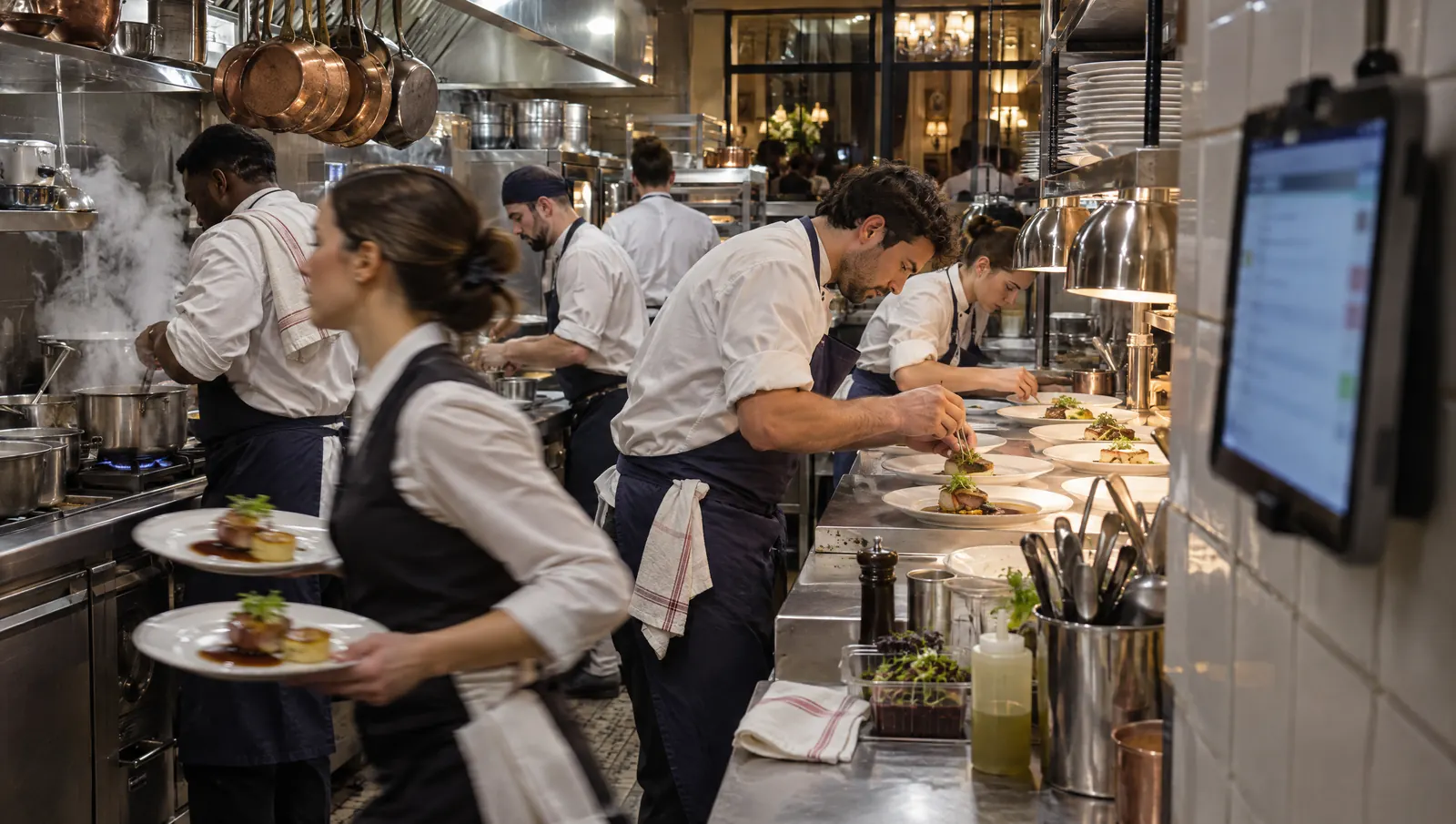
The restaurant of tomorrow does not look like a sci-fi kitchen. It looks like today's, with one difference: information reaches the station at the moment of the task, instead of sitting in a binder, a group chat or the chef's head. Ten changes are already under way, from voice in the kitchen to checks logged while the work is being done. Each can help the team or turn against it, depending on how it is designed. Craft, taste and the guest stay in human hands.
Friday, 8:15 p.m., in the weeds
Maxence has been on the hot line for three weeks. A ticket for a six-top comes through marked "no tree nuts". He is unsure about tonight's sauce. He does not leave his station: he asks, and the approved sheet for the sauce comes up on the wall tablet, dated Tuesday. Hazelnut in the garnish. He calls it to the pass. Rania, the sous chef, swaps the garnish and logs it.
Jean-Pierre, the head chef, never had to leave the pass or answer from memory. By the end of the night, Maxence's question and the garnish swap sit in the day's log with the time next to them. Nobody has to remember.
(Scene and characters are fictional.)
Thirty seconds of service, and half the list below is already in it.
The ten changes, one by one
1. Information comes to the station
A line cook no longer crosses the kitchen to find the right procedure: it shows up where they work, on the site tablet or their phone. It is the simplest change, and the most useful.
What can go wrong: one more screen people check instead of asking. Information at the station does not replace the chef who shows the move the first time.
2. Voice for back-of-house stations
The line cook asks without putting the knife down. At the dish pit, in the storeroom, at opening and closing, that is often easier than walking to a tablet. On the floor or at the counter, we advise doing without: a guest who hears someone talking to a device soon wonders who is listening. It is a house rule to agree on, not a limit of the tool.
The trap: a chatty assistant. In a kitchen, every second spent talking is taken from service. A good assistant answers in one sentence, then goes quiet.
3. Procedures that are live and dated
The closing checklist is no longer a laminated sheet from 2019. It carries a date and the name of whoever approved it. When a step is wrong, someone flags it and it gets fixed for everyone.
Watch out for two versions of the truth. If the binder survives next to the tool, nobody knows which one counts. One of them has to be retired, out loud.
4. AI that analyses for managers
A manager no longer reads twenty shift reports on Sunday night. They ask what needs their attention and get facts brought together: a temperature check missed three Sundays running, an action agreed and never closed. Whether to raise it at Monday's pre-shift is still their call.
The risk: sliding from analysing the work to judging the people. A team that finds out a tool is giving each of them a score soon stops using it to ask questions.
5. Checks logged during the task
The walk-in temperature is logged when someone reads the thermometer, not at the end of the day from memory. You say the unit and the reading, the tool repeats the number, the person confirms. An out-of-range reading alerts the site's managers.
The trap: dictating without reading. Voice keeps a check from getting lost, it does not make it true. A reading dictated from memory is still a fake reading, just a faster one.
6. Learning on the job
Training is no longer half a day in a back room. It happens at the station, on real situations, with a named trainer and time set aside to look back at what happened. In France this has a legal framework, AFEST, set out in Article D6313-3-2 of the Labour Code.
The risk: believing that a tool with every answer trains people. An apprentice can read the plating order three times and still get the plate wrong in the rush. A skill is signed off by a person, on the job.
7. Several languages in the same kitchen
Many teams speak three or four languages. Understanding a procedure in your own language, without feeling embarrassed to ask again, changes how safe a station is. Tsuno's interface exists in French and English, and the welcome booklet adapts to the person's language.
Watch out for safety procedures translated without review. A good tool keeps the original visible next to the translation, and a free translation never counts as an approved sheet.
8. Being open about data
In the locker room, the question comes up fast: does what I ask go straight to the boss? If the answer is written down, on a page anyone can reread, the tool stands a chance. If not, the team goes back to the notebook in their apron pocket.
The trap: the vague promise. "We won't do anything bad" reassures nobody. A useful rule can be checked, and it separates what is in place from what is not yet.
9. Less double entry
The photographed delivery note feeds receiving, and receiving feeds the supplier price list. What one part of the system records, the next one sees, and nobody copies the same number three times.
The risk: automating a mistake. A wrong number that travels everywhere unchecked does more damage than a wrong number in one notebook. Doubtful cases must go back to a person.
10. Guests informed from a reliable source
A guest asks whether there is sesame in the dish. The answer should not come from the server's memory, or from an AI that "thinks not". Under EU law (Regulation (EU) No 1169/2011), information on the 14 regulated allergens must be available for non-prepacked food, and in France it must be given in writing (Decree No 2015-447 of 17 April 2015). The change ahead: the approved recipe sheet becomes the only source, for the team and for the guest.
The trap: a smooth, wrong answer. On allergens, a good tool shows the sheet or says it does not know. It never summarises from memory.
The ten changes at a glance
| Change | What it brings | The risk | The rule that protects |
|---|---|---|---|
| Information at the station | Fewer trips, fewer interruptions | Replacing a live demonstration | The first move is shown |
| Voice back of house | Ask without stopping the task | A chatty assistant, or one out front | Short answers, recommended off the floor |
| Dated procedures | One version that counts | Two parallel truths | Retire the old version |
| AI for managers | Facts brought together earlier | Judging people | People decide |
| Checks during the task | Real time, real person | Dictating without reading | Repeat, confirm |
| Learning on the job | Training on real situations | Confusing answers with skill | Sign-off by a person, on the job |
| Several languages | Understanding without embarrassment | Unreviewed translation | Original visible, approved sheet |
| Open about data | The team's trust | Vague promises | Written, checkable rules |
| Less double entry | Time given back | An error spread everywhere | Doubtful cases reviewed by a person |
| Allergens | A reliable answer for the guest | Answering from memory | The sheet, or "I don't know" |
Common mistakes
- Starting with the tool instead of the problem. Ask the team first what wastes their time this week.
- Launching everything at once. One change a month, tested on one station, beats ten announced at pre-shift.
- Forgetting the quiet ones. The dishwasher who never asks a question in a meeting is often the one who most needs the procedure at the station.
- Presenting the tool as a control. If it is there to watch people first, it will never help them.
What to measure
- How often the chef gets interrupted during service for a procedure question, before and after.
- The share of checks logged at the actual time rather than at the end of the day.
- The time between a step being flagged as wrong and the sheet being fixed.
What will not change
In the opening scene, Maxence found the sheet, but Rania chose the replacement garnish and tasted it before it went out. Craft, taste, looking after the table and the decision stay with the team. We go further in our pillar article on the future of work in hands-on jobs.
Where Tsuno and San fit in
Tsuno already covers part of this list: checklists and procedures by site, temperature checks by unit with thresholds, receiving checks, skills signed off and dated by a manager, and an interface in French and English. Managers can ask questions of their business's memory and see the facts behind each answer.
Tsuno San is the intelligent voice assistant for frontline teams, connected to those procedures, tasks, checklists and checks. It acts within the person's permissions, prepares every action and waits for their confirmation. San Voice, the voice interaction, is available as a demo; San Audio (hands-free) and San 360 are being explored and tested. On allergens, showing the approved sheet instead of answering is the principle we are building San on, and we test it in real kitchens before calling it done. On-the-job training is organised with Tsuno Compétences. What we do with data is set out on our Trust page.
Further reading
For the big picture, start from the pillar article mentioned above, then read the place of people when the tool has the answer. On the assistant itself, see Tsuno San, the work companion for frontline teams. For change 10, read is there sesame in it? Why San shows the sheet instead of answering. And for change 4, AI for frontline managers.
Key takeaways
In the restaurant of tomorrow, the right sheet reaches the station when the task happens, with its date and the name of whoever approved it. Each of the ten changes can help or get in the way depending on how it is set up: try it on one station before rolling it out.
Frequently asked questions
What will AI really change about working in a restaurant?
Mostly access to information: the right procedure at the station, at the moment of the task, on screen or by voice. Checks will be logged during the task, double entry will shrink and managers will get facts brought together. Craft, taste and the guest stay human.
Will AI replace cooks and servers?
Nothing we see on the ground points that way. AI helps people find information, prepare an action or bring facts together. It does not fillet a fish, taste a sauce or calm down an unhappy table.
Is a voice assistant in a kitchen realistic?
Yes for short questions and routine checks, as long as the assistant answers briefly, knows the business and asks for confirmation before acting. At Tsuno, the San Voice interaction is available as a demo; full hands-free use is still being explored.
How can a restaurant give guests reliable allergen information?
Under EU law (Regulation (EU) No 1169/2011), information on the 14 regulated allergens must be available for non-prepacked food, and France requires it in writing. The only reliable source is the business's approved, dated recipe sheet, never an answer from memory, human or AI.
What are the risks of moving restaurant procedures into software?
Creating a second version of the truth if the binder survives, letting sheets age without a review date, or turning the tool into surveillance. A digital procedure should be dated, approved by a named person and easy to fix when a step is wrong.
Keep reading
Future of work
A companion, not a supervisor
A good frontline tool helps the person doing the work first: answer, remind, report. Once it makes numbers about them for someone else, it turns into control.
Future of work
Conversational assistant or job assistant: where is the line?
A conversational assistant answers anyone with no context; a job assistant knows your location, acts within your permissions and asks for confirmation.
Future of work
The place of people when the tool has the answer
When the tool answers the how, the chef still owns the why, taste, judgment, welcome, example and decisions. As long as the team keeps talking.