
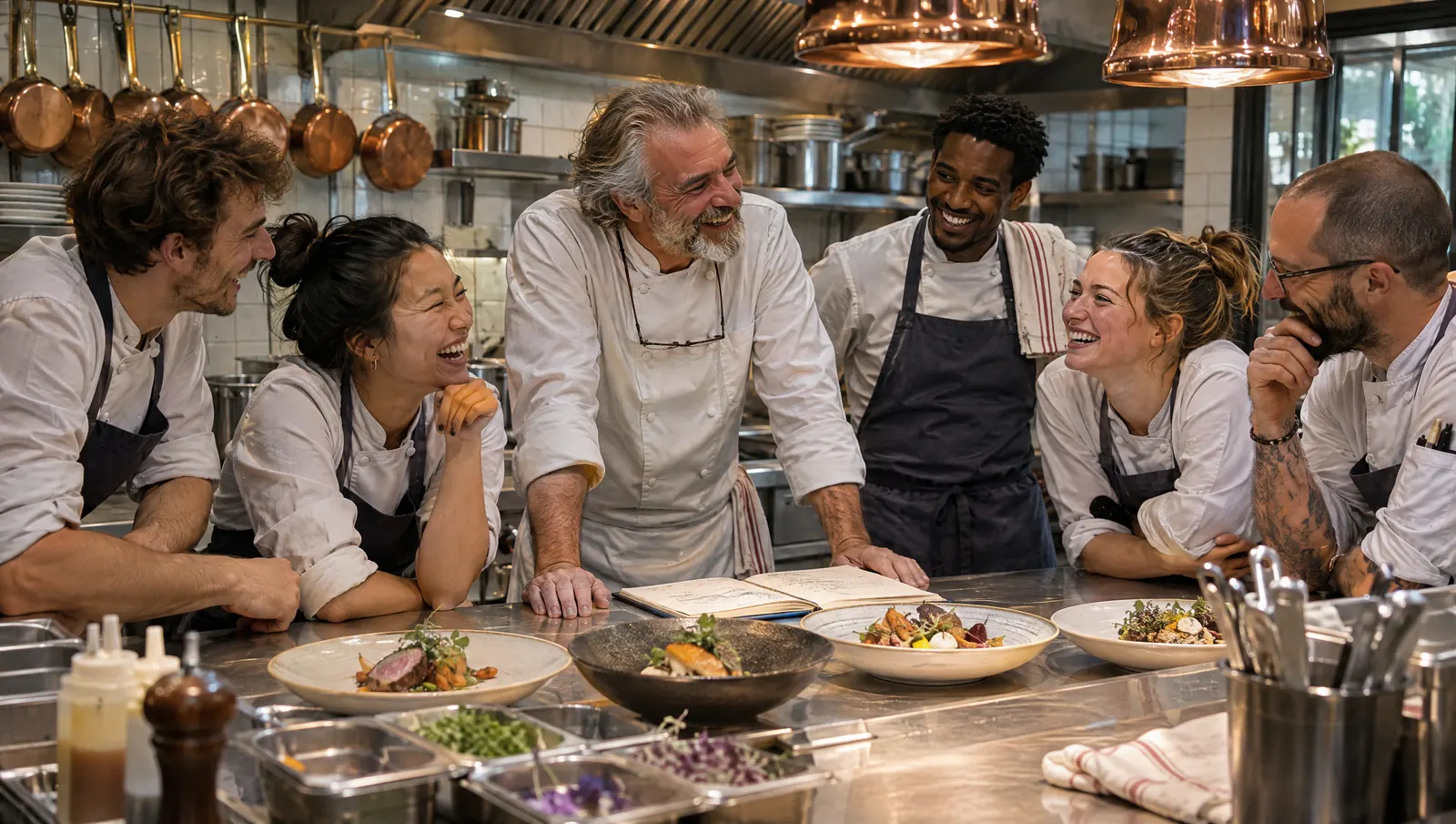
Once the tool can tell a new hire what temperature to store salmon roe at, the chef, the manager and the experienced cook still have everything else: explaining why, tasting, making the call when something goes wrong, welcoming people and answering for their decisions. A work assistant saves the time spent on questions repeated twenty times a week. The risk to watch is less about wrong answers than about silence: if every question goes to the screen, the new hire stops talking to the veterans.
Saturday, 6:05 p.m., at the pass
The briefing starts in ten minutes. Jade joined the cold station three weeks ago. During prep, she asked the assistant her questions: the storage temperature for the salmon roe, the order of the checklist, how to plate the tartare. Short answers, taken from the house's own sheets. She didn't bother anyone.
Raphaël, the chef, notices. And he notices something else: Jade hasn't said a word to Dominique, his sous-chef, all afternoon. Dominique has twenty years in kitchens and a line ready for every rookie mistake. Nobody asked him for it.
At the briefing, Raphaël passes round the test plates. He asks Jade what she thinks of the tartare. She hesitates: "It matches the sheet." Dominique grins: "Matches, sure. Now taste the shallot. It was cut at noon, it's already turned. The sheet won't tell you that." Everyone laughs, Jade included. She will remember the shallot, and above all that there is someone to ask that kind of question.
(Scene and characters are fictional.)
What the tool can do, and what it can't
The how is a memory problem
Many kitchen questions are memory questions: a temperature, a time, a step, where a product lives, what is left on the checklist. They have a written answer, or they should. Answering them twenty times a week wears the chef down and embarrasses the new hire, who doesn't always dare to ask twice. That is where an assistant connected to the business's own procedures earns its keep.
The why is not on the sheet
The sheet says to cut the shallot at the last minute. It doesn't say what a shallot cut too early tastes like, or why the house cares. The why is passed on by tasting, showing, telling the story of a past mistake. Someone who understands the why can adapt on the day the situation goes off script.
The unexpected needs someone to judge
A supplier delivers a different variety. A table flags an allergy at the last minute. The oven dies at 8:30 p.m. These moments call for judgment on the spot, built on experience and on knowing who is on shift that day. A tool can show the fallback procedure. It doesn't decide to pull a dish from the menu.
Relationships can't be delegated
The night a commis breaks their first sauce, someone has to tell them everyone has been there. The day a technique finally looks clean, someone has to notice. Those moments don't go through an assistant, and they are often what makes a new hire decide to stay.
What stays with the chef, the manager and the experienced cook
Once the tool handles memory questions, here is what is left to do, and none of it can be handed off.
- The why. Explaining the reasons behind a standard, so it is understood and not just followed.
- Taste. Tasting, getting others to taste, fixing the seasoning before the plate goes.
- Judgment in unexpected situations. Making the call when the sheet is no longer enough.
- Welcome. The first day, the first week, the first mistake.
- Relationships. Knowing everyone, seeing who is struggling, knowing who to trust with what.
- Example. A chef who skips the checklist teaches that it is optional, whatever the tool says.
- Decisions. Approving a procedure, signing someone off on a station, changing a rule.
- Responsibility. Whoever decides answers for it. A tool is responsible for nothing.
Responsibility doesn't transfer
This is the most serious point. When an answer comes from a screen, it is tempting to say "the tool told me so". A good tool makes that sentence impossible. It answers from what the business has approved and shows where its answer comes from. When it prepares an action, a named person confirms it, and that name is what appears in the log. If a plate goes out with an undeclared allergen, "the tool said so" is not an answer you can give the guest.
The risk of a team that stops talking
An assistant that answers well can damage a team, simply because it is comfortable. Asking the tool is quick and nobody sees you hesitate. Going up to the sous-chef mid-rush means risking a sigh. Slowly, the questions find a new address.
What you lose without noticing
When Jade asks Dominique how to cut the shallot, he also shows her how to hold her knife, and notices along the way that her board is a mess. For Dominique, being asked is also a sign of respect. When those exchanges disappear, the veteran feels useless and the new hire is left alone with the sheets.
Warning signs
- New hires know the procedures but not their colleagues' names.
- Experienced staff say "nobody asks me anything anymore".
- Mistakes in taste or finish persist even though every step is followed.
- The briefing has turned into reading out instructions, with no questions.
How to keep the team alive
The answer is not to take the tool away. It is to surround it with moments that don't go through it.
- Name a mentor for every new hire. One specific person, known to everyone, for the questions that aren't on the sheet. Mentoring isn't improvised, it is organized: who, on which station, for how long.
- Hold the briefing standing up, at the pass. Five to ten minutes, with a tasting or an open question. That is when the why gets passed around.
- Separate the two kinds of questions. Memory goes to the tool: a temperature, a step. Doubt, mistakes, taste and anything about a person go to a human. Tell the team exactly that.
- Expect the tool to refer people to a human. When a question goes beyond the sheet, or the sheet is missing, a good assistant says so and tells you who to ask. It doesn't fill the gap.
- Get experienced staff to write things down. What Dominique knows about shallots deserves a line on the sheet, with his name on it. The day a new hire reads it, they also know who to go and see.
- Look back at the week. Fifteen minutes on Sunday: what was asked often, what was missing, what came as a surprise.
Who answers what
| Question | Who should answer | Why |
|---|---|---|
| "What temperature do I store this at?" | The tool, from the approved sheet | Written, stable answer that shouldn't be improvised |
| "What's left on the checklist?" | The tool | Memory information, useful without interrupting anyone |
| "Why do we do it this way here?" | The chef or an experienced cook | The why comes from experience |
| "Does this taste right?" | The chef, by tasting | No screen can taste |
| "This isn't the delivery we ordered, what do I do?" | The manager, helped by the procedure | Judgment on the spot, a decision to make |
| "Allergens for table 12?" | The approved sheet, then the manager | Critical topic: show the sheet or refer to a human |
| "I messed up, I feel useless" | The mentor or the manager | Relationship, trust, support |
| "Am I ready to run the station alone?" | The manager | A human decision, based on facts |
Common mistakes
- Presenting the assistant as the one that "knows everything". It knows what the team has written. Saying so protects the place of experienced staff.
- Dropping the briefing because "it's all in the tool". It is often the only moment in the day when the whole team talks.
- Leaving a new hire alone with the tool in their first week. They'll learn the steps, not the house.
- Measuring success by the number of questions asked to the tool. If that number climbs while nobody goes to the veterans anymore, something is wrong.
- Forgetting to update the sheets after a spoken correction. The kitchen's truth and the tool's truth drift apart, and nobody knows which to follow.
What to measure
- The number of sheets improved by an experienced team member in a month. It shows the tool is serving knowledge transfer rather than bypassing it.
- How new hires answer one simple question after three weeks: "Who do you ask when it isn't on the sheet?" If they can't give a name, a mentor is missing.
- The number of questions the team asks during briefings over two weeks. If it drops to zero, the briefing has turned into reading out instructions.
Where Tsuno and San fit in
Tsuno San is the intelligent voice assistant for frontline teams, connected to the business's procedures, tasks, checklists, routine checks and information. It answers from what the team has written and approved. It acts within the person's permissions, and every action is prepared, then confirmed by them. On critical topics, our design principle is that it shows the sheet or refers you to a manager rather than answering from memory; this is what we are building and testing. Only San Voice, the voice interaction, is available today as a demo; the other tracks and their status are on the Tsuno San page.
San replaces neither the chef, nor the mentor, nor training. To organize knowledge transfer itself (learning paths, hands-on practice, observation in real situations, progress tracking), there is Tsuno Compétences. And if you expect a tool to lead your team for you, none will, ours included.
Further reading
For the big picture, read the future of work in hands-on jobs and the pillar page Tsuno San, the work companion for frontline teams. On passing on skills, see train people without turning your best employee into a full-time trainer. On the tool's limits, why an assistant must be able to say "I don't know" and what San never does.
Key takeaways
When the tool handles memory questions, the chef gets time back to explain, taste and decide. For that time to benefit the team, every new hire needs a name to go to, and the briefing has to stay a moment where people ask questions.
Frequently asked questions
If an assistant answers the team's questions, what is the chef for?
The chef keeps everything a tool cannot do: explaining why things are done this way, passing on taste, judging an unexpected situation, welcoming people, setting the example, deciding and owning the decision. The tool answers the how; the chef holds the rest.
Can a kitchen assistant replace learning from experienced staff?
No. It makes what the team has written and approved easy to reach. A technique, a correction at the right moment, the trust given to a new hire all go through a person. A good tool points people to the experienced colleague instead of taking their place.
How do you stop a team from talking less because of an assistant?
Keep moments of conversation that do not go through the tool: the pre-service briefing, a named mentor for every new hire, a short review at the end of the week. And choose a tool that refers people to a human when a question goes beyond the written procedure.
Who is responsible if the team follows the assistant's answer?
Responsibility stays human. The tool gives access to a procedure the business has approved; the manager who approved it is the one who decides. In Tsuno, every action is prepared by the assistant, then confirmed by the person, and it is logged.
Is it wrong to ask the tool instead of a colleague?
Not for a memory question: a temperature, a step, the order of a checklist. It saves interrupting someone in the middle of a rush. What should stay a conversation is doubt, mistakes, taste and anything that concerns a person.
Keep reading

Future of work
10 changes in the restaurant of tomorrow
Information at the station, dated procedures, checks logged during the task, AI for managers: ten changes already under way, and what can go wrong with each.
Future of work
A companion, not a supervisor
A good frontline tool helps the person doing the work first: answer, remind, report. Once it makes numbers about them for someone else, it turns into control.

Future of work
Conversational assistant or job assistant: where is the line?
A conversational assistant answers anyone with no context; a job assistant knows your location, acts within your permissions and asks for confirmation.