
A frontline assistant that cannot say "I don't know" will eventually make things up. In a kitchen, a plausible but wrong answer costs more than an admission of ignorance, because someone acts on it. A good assistant asks again instead of guessing, tells "nothing has been reported" apart from "it's compliant", cites its dated source, and hands anything critical to a person.
Saturday, 12:15 p.m., at the pass
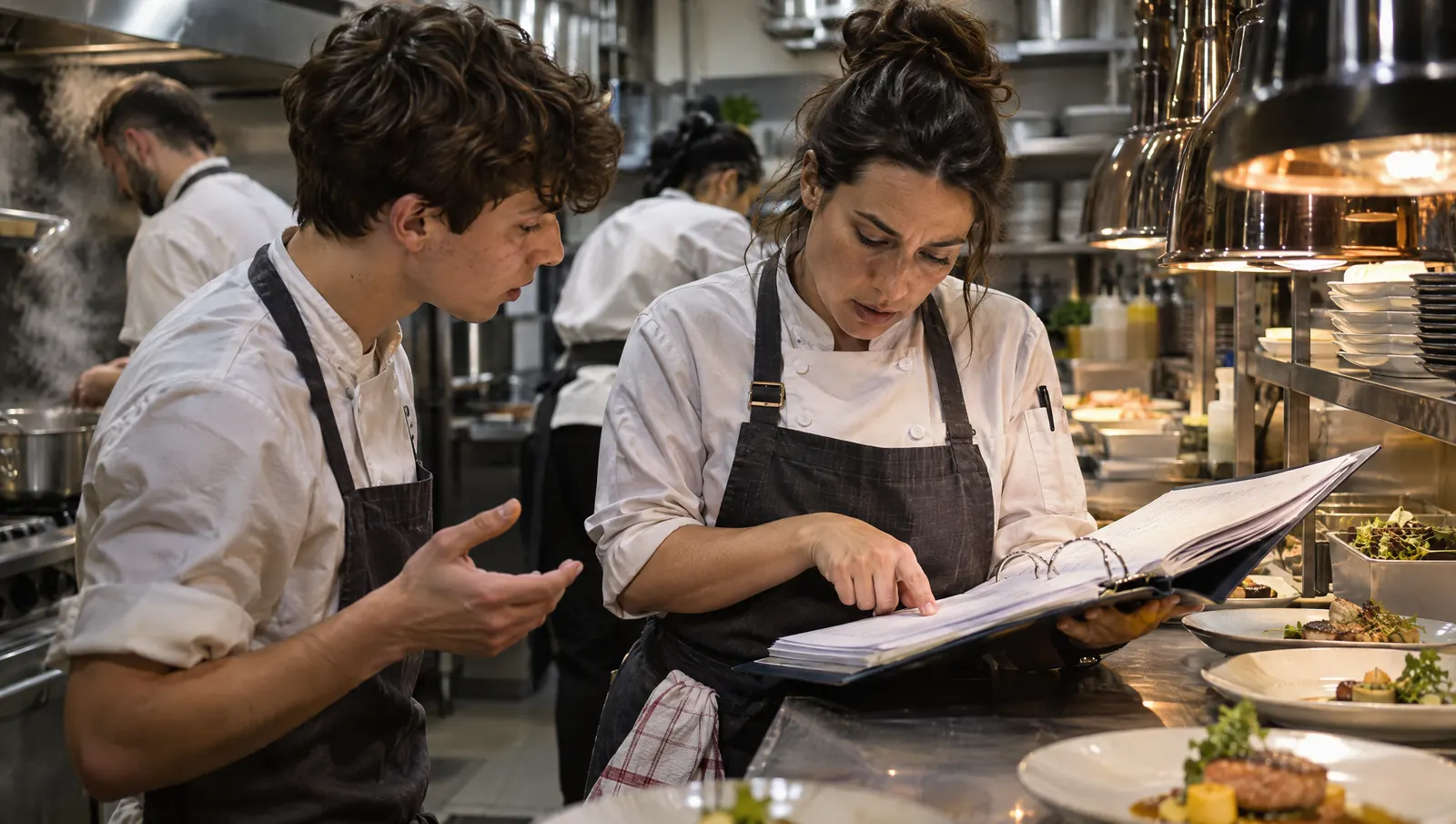
The first weekend service is starting. Yanis, a commis who joined ten days ago, comes back from the floor with a question: "The sauce on the cod, is it dairy-free? A guest is asking." Nadia, the head chef, knows the answer. She knows that sauce. She has made it two hundred times.
She still opens the recipe binder, flips three pages and puts her finger on the line. "Butter mounted in at the end. So no. Tell her we can offer the jus instead, I'll check the jus sheet."
It takes twenty seconds. It does not come from doubting her memory. It comes from experience. Nadia knows recipes drift, that a sous-chef may have changed a stock, that a supplier may have changed a base. Above all, she knows her answer is going to the floor and onto someone's plate.
That is exactly the behavior to expect from an assistant. Not the rushed commis who says "I think so" to avoid bothering anyone.
Why a tool that always answers ends up doing harm
Fluency looks like competence
A well-phrased answer is reassuring. It sounds like someone who knows. But a conversational assistant is built to produce an answer, not to hold back. When it lacks the information, its natural tendency is to fill the gap with what is likely. In a kitchen, likely is not data.
Silence becomes proof
"Is fridge 2 OK?" If nobody has logged a reading since yesterday, a tool that says "no issues reported" is telling the truth. But the cook hears "it's compliant". No alert is not a measurement. A good tool says: "Last reading yesterday at 3 p.m., 3 °C (about 37 °F). Nothing since."
The most likely meaning is not always the right one
Under the hood, "the white sauce" might mean the béchamel, the yogurt sauce or the beurre blanc. A person asks "which one?". A tool that quietly picks the most common one is rarely wrong, and on the day it is, nobody notices.
A single success rate hides the serious error
This is the most misunderstood point. Picture a team of fifteen, each asking ten questions a day: 150 questions. A tool that got only one in twenty wrong would produce seven or eight misses a day. The real question is not how many. It is which ones. Eight times "say that again, I didn't catch it" is annoying. One "yes, no sesame" when there is sesame is an incident.
That is why we do not publish an overall success rate for San. A global percentage says nothing about safety. Only a breakdown by type of error does.
The rules of an assistant you can trust
- Ask again rather than guess. If the question is ambiguous or misheard, it rephrases and asks for confirmation. "Do you mean the béchamel or the beurre blanc?"
- Repeat numbers before recording them. "3 °C for the walk-in, is that right?" A misheard temperature becomes a false record signed by someone.
- Separate a reading from a gap. It says what was done, when, by whom, and what is missing. Never "all good" without a basis.
- Cite its source and date. "According to the Opening sheet, version of November 4." The person can check, and knows whether the sheet is old.
- Show rather than summarize on critical topics. Allergens, ingredients, temperatures, chemicals, safety: it displays the approved sheet, or says it has none.
- Refer to a named person. "I don't have a sheet for today's special. Ask the head chef." A referral with no one at the end is a dead end.
- Run nothing without confirmation. If it prepares an action, it summarizes the effect and waits for a clear "yes".
Types of misses, and what is acceptable
| Type of miss | Kitchen example | Consequence | Acceptable? | What the tool should do |
|---|---|---|---|---|
| Misunderstanding | Hood noise, the question is misheard | A few seconds lost | Yes | Say it did not understand and ask again |
| Ambiguity | "The white sauce": three possible sheets | Wrong sheet opened if the tool chooses alone | Yes, if it asks | Offer the options, let the person choose |
| Missing data | No reading for fridge 2 since yesterday | None, if it says so | Yes | Say what is missing and since when |
| Silence read as compliance | "Nothing reported" heard as "all compliant" | False sense of safety | No | Describe a gap as a gap |
| Misrecorded number | 8 °C logged instead of 3 °C, or the reverse | False record, missed or false alert | No, if not confirmed | Repeat the value and wait for confirmation |
| Answer from memory on a critical topic | "No, no allergens" with no sheet | Risk to a guest or an employee | Never: target is zero | Show the approved sheet or refer to the person in charge |
| Unwanted action | A task created or checked off by mistake | Confusion, lost trust | No | Prepare, summarize, wait for confirmation |
The column that matters is the fourth. The first three rows are the normal cost of talking in a kitchen. The last four are design failures, and a good tool is built so they do not happen.
Common mistakes when choosing or testing an assistant
- Judging it on eloquence. A smooth demo proves nothing. What counts is what it does when it does not know. We covered this in talking to your restaurant: gimmick or new interface?.
- Testing only easy questions. Ask something you know is not in your sheets. If it answers anyway, stop the test.
- Treating "I don't know" as a failure. It often means a sheet is missing. The right reflex is to write it, not to blame the tool for saying so.
- Accepting an answer with no date. A 2023 procedure quoted with confidence is a trap. The date is part of the answer.
- Letting the tool settle a people issue. It brings facts together. It does not judge a person or replace the manager's decision.
What to measure
- Critical errors observed on allergens, temperatures and safety. The target is zero, and every case is reviewed.
- The share of answers that cite their source and date, on a sample of twenty real questions.
- The number of "I don't know" answers that lead to a sheet being written or corrected within the week. It is the best sign that an admission of ignorance was useful.
Where Tsuno San fits in
Tsuno San is the intelligent voice assistant for teams, connected to the Tsuno environment: procedures, tasks, checklists, routine checks, equipment and location information. San Voice, the voice interaction, is available in demo. San Audio, the hands-free experience, is under exploration and testing.
The rules in this article are San's design principles, not a promise of infallibility. On critical topics, San is designed to show the location's sheet instead of summarizing it, or to say it has none and refer to the person in charge. When data is missing, it says so. Spoken confirmation of every number dictated aloud is part of what we are working on. San acts within the person's permissions: it only sees and does what they can already see and do in Tsuno. Every action happens in two steps: San prepares and summarizes, the person confirms, and it is recorded. Tsuno brings the facts together. People decide.
San will never answer better than your sheets. If there are none, it will say so, and that is useful. The details are on the Tsuno San page.
Further reading
For the big picture, read the pillar page Tsuno San, the work companion for frontline teams. The most sensitive case is covered in allergens: why no tool should answer from memory. On the gap between a green screen and a kitchen under control, see compliance theater. And for the line between a tool and a judgment, AI should not judge your employees.
Key takeaways
A frontline assistant is judged by what it does when it does not know: it asks again, shows its dated source and refers to a person. An overall success rate says nothing about safety; what counts is keeping critical errors at zero.
Frequently asked questions
Why is an assistant that always has an answer dangerous in a restaurant?
Because a fluent but wrong answer is followed by an action: a plate goes out, a check is signed, a product is stored. Admitting ignorance costs a few seconds. A mistake on an allergen or a temperature can put a guest in hospital or close a kitchen.
What should an assistant do when it has not understood the question?
Ask again, or rephrase and ask for confirmation, instead of picking the most likely meaning. For a number spoken aloud, it should repeat the value before recording it.
What is the difference between nothing reported and compliant?
The first describes missing information, the second a verified fact. A good tool never turns silence into compliance: it says what was recorded, when, and what is missing.
Is a high success rate enough to trust an assistant?
No. A single overall figure mixes harmless misses with serious errors. Think in categories instead: misunderstandings fixed by asking again are acceptable, errors on critical topics must be kept at zero.
On which topics should an assistant refer to a person?
Allergens, ingredients and changed recipes, out-of-range temperatures, cleaning chemicals, first aid and employment law. It shows the location's approved sheet or says it has none, then names who decides.
Keep reading
AI and tools
General voice assistant or a companion that knows your workplace?
For a timer, a consumer voice assistant is enough. For your recipes, permissions and team, you need a work companion. An 8-point comparison.

AI and tools
San and MCP: one memory, many ways to talk
Procedures, tasks, logs and incidents stay in one place. San by voice, Tsuno on screen or your AI assistant: same permissions, same rules.
AI and tools
Why a general AI does not know your restaurant
A general AI knows what HACCP is, not that your cooler 2 read 6 °C last night. To talk about your place, it has to be connected to your dated facts.