
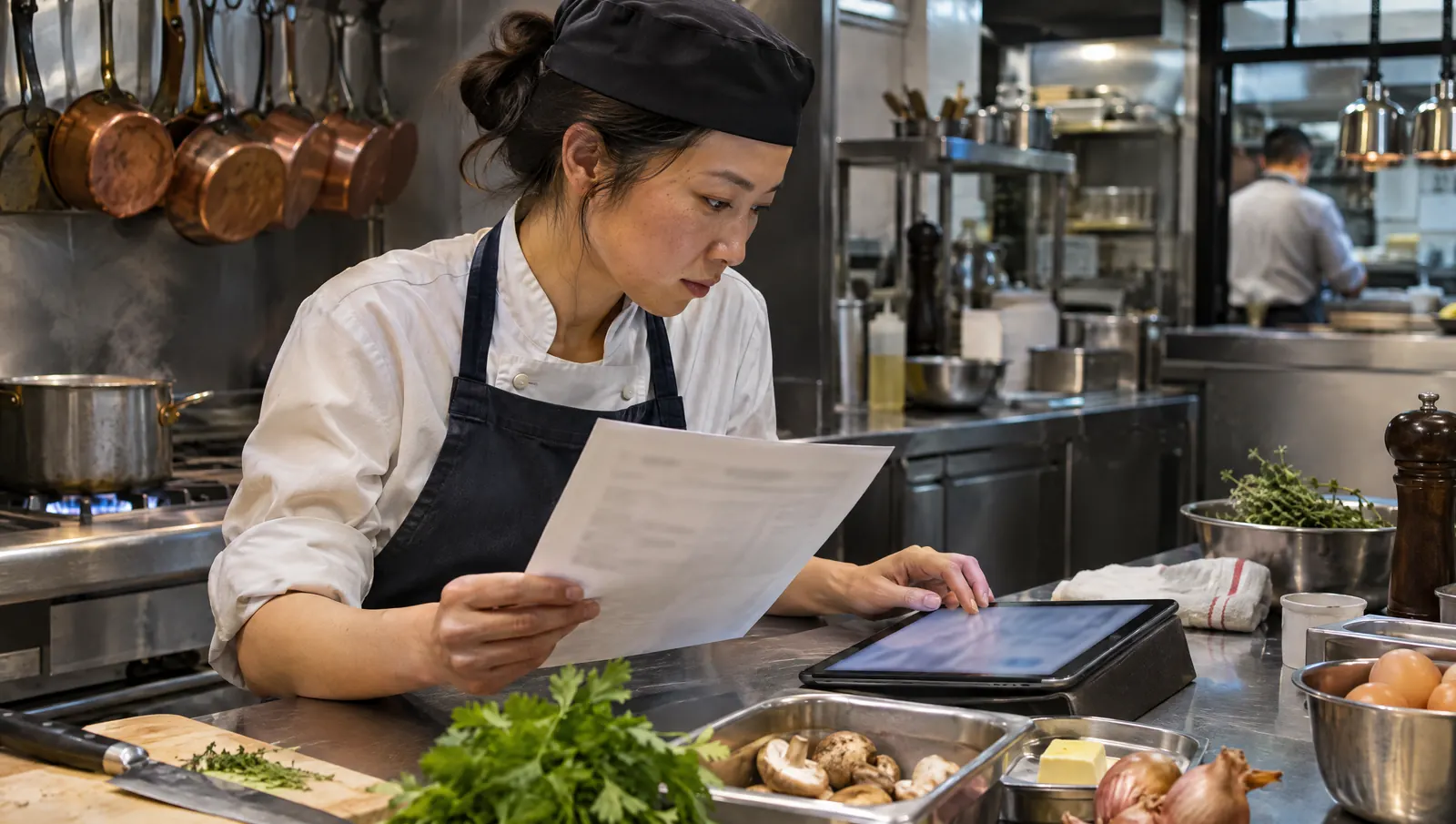
A general AI knows a great deal in general: what HACCP is, how to build a tiramisu, what to check in a walk-in cooler. It does not know that your cooler 2 read 6 °C (about 43 °F) last night, or that your tiramisu recipe changed on Tuesday. To talk about your restaurant, it has to be connected to your facts, within your rights and with its sources visible. For writing, rewording or thinking things through, it does fine without that.
Thursday, 10:20 a.m., at the pastry station
Nathalie is head chef at a busy brasserie. On Tuesday she changed the tiramisu recipe: less sugar, stronger coffee, and the cream whipped separately. The new recipe card is approved in Tsuno. The old paper card is still taped above the counter.
Youssef, a commis who started on Monday, is doing prep. He is unsure about quantities and asks the AI assistant on his phone: "Tiramisu recipe for 30 portions?" The answer is tidy, well balanced, with a tip about the mascarpone. It is a very good tiramisu recipe, just not the house one.
Nathalie walks in, sees the bowls, and lays the paper card next to the tablet. Two house versions and one from the internet. She takes the paper card down and shows Youssef the screen.
The same morning, Pauline, the general manager, wonders whether cooler 2 needs a repair call. She asks her assistant. It explains very well how to monitor a walk-in. It has no idea that last night's reading was over the limit.
(Fictional scene and characters.)
What a general AI knows, and what it cannot know
General knowledge
A general AI has learned from a huge amount of text. It knows the broad principles of food safety, cooking techniques, how to lay out a schedule or write to a supplier. It knows, for example, that in the EU food businesses must run procedures based on HACCP principles (Regulation (EC) No 852/2004, Article 5). That knowledge is useful and often right.
Your own facts
What your restaurant has decided, measured or observed is written nowhere in what it learned. Your limit for cooler 2. The new tiramisu card. Whether last night's closing checklist was done. Who has completed the hygiene training. Those facts only exist in your place.
Dates change everything
Even a correct fact goes stale. Monday's recipe is no longer right on Tuesday. A reading that was fine last week says nothing about last night. An assistant that does not know when a fact was recorded cannot tell you whether it still holds.
The three risks of asking it about your place
A plausible but generic answer
That is Youssef's case. The answer is good in general, so it looks good for you. Nobody spots the gap until it is on the plate: a dessert that is too sweet, or an allergy nobody planned for because an ingredient changed.
Making things up to fill a gap
If you ask an unconnected assistant "what was cooler 2 at last night?", it should not answer. If it does, it is inventing. A general AI is built to produce an answer, not to say it does not know. That is why we argue that an assistant must be able to say "I don't know".
Copy-pasted data
To help the assistant, people paste in text: a schedule export, a shift report, a staff list. Three problems. The data leaves your workspace. The access rights disappear: whatever you paste, the assistant handles without knowing who is allowed to see it. And you may slip in personal information about your staff, which you remain responsible for under EU data protection law (GDPR).
General knowledge or your own facts: how to tell
| Your question | What a general AI can say | What a good answer needs |
|---|---|---|
| How should I monitor a walk-in cooler? | The principles, very well | Nothing more, this is general knowledge |
| Was cooler 2 within limits last night? | Nothing reliable | The equipment's dated reading and your limit |
| What is the tiramisu recipe? | A recipe from the internet | The approved house card, with its date |
| Which allergens are in today's dessert? | A generic and dangerous list | Your business's card, or "I don't know" |
| How do I write a clear instruction for the dish station? | A good draft to review | Nothing more, apart from your review |
| Was closing done last night? | Nothing | The site's checklist: done, not done, or missing |
| Translate the welcome instructions into Spanish | A good first draft | A review by someone on the team |
How to give it context the right way
No need to give up the assistant you like: just connect it to your facts instead of pasting text into it.
- Connect, do not paste. An assistant connected to the business's data looks up the fact when you ask. It does not keep a stale copy in the chat.
- Keep your rights. Connected to Tsuno, the assistant stays within your scope: a site manager does not see another site just because they are going through an assistant.
- Demand sources. The answer should be able to show the facts it used: the reading, the card, the checklist, with their dates.
- Demand the gaps. When nothing is recorded, the answer has to say so rather than let you assume all is well.
- Keep control of actions. A task or change prepared by the assistant stays a draft until you have read and confirmed it.
- Leave people's private lives out. Do not ask an assistant to note that an employee is ill or pregnant. Tsuno refuses to record that kind of sensitive data and offers to log a dated, observed fact instead.
This kind of connection has a name, MCP, which we explain in plain words in MCP: connecting your AI to your business, explained for frontline trades.
When a general AI is perfectly fine
It would be wrong to say a general AI is useless in a restaurant. For anything that does not need a precise, dated fact about your place, it does the job well.
- Drafting a message to the team, a job ad, a reply to a supplier.
- Rewording an instruction that is too long into three short sentences.
- Translating a simple text for an employee who reads another language more easily, to be checked by someone.
- Thinking through how to organize something: splitting prep, which questions to ask a candidate.
- Preparing a meeting or summarizing a document you chose to give it, with no personal data in it.
The rule fits on one line: general knowledge, general assistant; your own facts, an assistant connected to your data.
Common mistakes
- Judging the assistant on how well it writes. A well-written answer can still be a recipe that is not yours.
- Leaving two versions of a card in circulation. If the paper card contradicts the approved one, no tool will save the service.
- Pasting a full export "to save time". You lose dates and rights, and you take data out of your workspace.
- Asking an unconnected assistant about allergens. On that topic, only your business's card counts. See allergens: why no tool should answer from memory.
- Assuming any homemade setup will do. Rights, provenance and confirmation are the hardest parts to build, as we explain in why not build Tsuno with ChatGPT, Notion and Make?
What to measure
- Out of ten questions you ask your assistant about your restaurant, how many answers show a dated fact from your own place.
- The number of duplicate cards (paper and screen, old and new) found on a walk around the kitchen.
- How often the assistant says "I don't have that information" in a week. Zero is not a good sign.
Where Tsuno and San fit in
Tsuno keeps what your business has written down and recorded: recipe cards, procedures, checklists, temperature logs per piece of equipment with their limits, tasks, dated facts. A reading over the limit alerts the site's managers. You can query those facts from Tsuno, where the assistant is called San, or from your usual assistant (ChatGPT, Claude, Mistral), with the same rights. Answers can show their sources, and when data is missing, Tsuno says so. Every action happens in two steps: the assistant prepares, you confirm. To see how it works on your own documents, the Tsuno San page introduces the assistant, and Trust and data sets out the rules.
Further reading
To ask your morning questions from the assistant you already use, read asking your restaurant questions from ChatGPT, Claude or Mistral. For the difference between a chatbot and a work tool, see conversational assistant or job assistant: where is the line?. And for the big picture, the pillar page Tsuno San: the work companion for frontline teams.
Key takeaways
A general AI knows the trade in general, not your place or what changed on Tuesday. Keep it for writing and thinking, and connect it to your dated facts, within your rights, whenever the question is about your restaurant.
Frequently asked questions
Does ChatGPT know my restaurant's recipes and procedures?
No. A general assistant knows recipes and rules in general. It does not know what your business has written down, or what changed this week, unless it is connected to your data.
Can I ask a general AI whether a cooler is within limits?
It can remind you of general principles. It cannot know what temperature your equipment showed last night, or which limit your business has set. For that you need the dated reading.
Is it a problem to paste company data into an AI assistant?
It is risky. You take data out of your workspace, you lose access rights and dates, and you may slip in personal information about your staff that you remain responsible for.
How can I give an AI my restaurant's context safely?
By connecting it to the business's data rather than pasting text: it then reads within your rights, shows its sources, says when data is missing, and any action waits for your confirmation.
What is a general AI perfectly good for in a restaurant?
Drafting a message, rewording an instruction, translating a simple text or thinking through how to organize something. Anything that does not require a precise, dated fact about your own business.
Keep reading
AI and tools
Why an assistant must be able to say "I don't know"
An assistant must be able to say 'I don't know': in a kitchen, a plausible wrong answer gets acted on. It asks again, cites its source and refers to a person.
AI and tools
12 questions to ask before connecting an AI to your business
Rights, confirmation, logs, data sent out, exclusions, leavers: 12 questions to ask a vendor before connecting your AI, and the answers to demand.

AI and tools
AI proposes, a human confirms: the two-step rule
In day-to-day operations, AI should never act alone: it prepares and summarizes, a person reads and confirms. Why it matters, how it works, and the traps.