
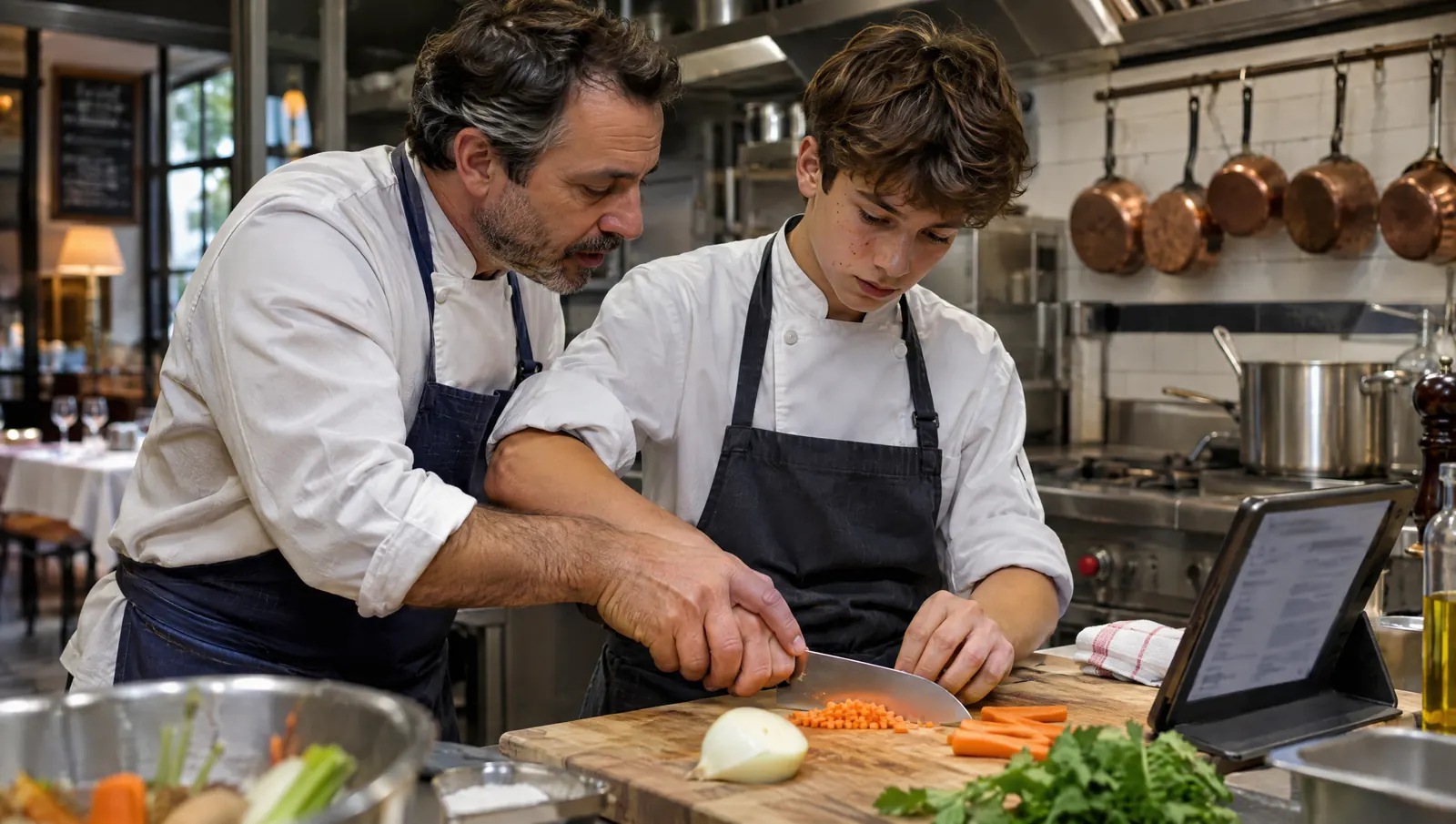
In on-the-job training, the assistant and the mentor do not do the same work. The assistant finds the sheet, recalls the next step and helps keep a record of the pathway. The mentor demonstrates the technique, explains why it is done that way, corrects on the spot, encourages and signs off the skill. Tell the new hire about this split on day one. Otherwise two traps are waiting: the mentor who offloads onto the tool, and the new hire who no longer dares to ask a person.
Wednesday, 10:15 a.m., Paul's brunoise
Paul has been an apprentice for nine days. This morning he is cutting a vegetable brunoise for a garnish. The recipe sheet is open on the station tablet: dimensions, weight, cutting order. He asks the assistant: "What size is the brunoise?" The answer comes from the restaurant's own sheet: two millimeters, a little under a tenth of an inch.
Gérald, his mentor, walks up behind him. He watches for thirty seconds without a word, then puts his hand over Paul's. "The sheet tells you the size. It doesn't tell you you're holding your knife too far from the heel. Look: fingers in a claw, blade against your knuckles. You'll go faster and keep your fingers."
Paul does three more passes. It is more even. Gérald heads back to his station, then turns round: "And when you're wondering if it's fine enough, don't ask the tablet. Show me."
That evening Paul has forgotten the two millimeters; he will ask again tomorrow. He remembers Gérald's hand.
(Scene and characters are fictional.)
Why the line gets blurred
The tool always answers, and never sighs
An assistant is available at 10 a.m. and at 10 p.m., and it never shows that you are bothering it. For a nervous new hire, that is comfortable. Little by little, they start asking it questions that are not memory questions.
The mentor is swamped
The mentor has their own station to run. When the tool answers the basic questions, it is tempting to let it answer everything, and only check on the new hire when something goes wrong.
Nobody said who does what
In most kitchens, the split between tool and mentor is never spelled out. Everyone makes it up. The new hire thinks they should look things up alone first; the mentor thinks the new hire will come if they need help. Both wait.
Sign-off drifts toward the tool
When the pathway is tracked in software, it is tempting to tick "done" because the modules are finished and the quiz is passed. A passed quiz proves you know the rule. It does not prove you can do the technique in the middle of service.
Splitting the roles
What the assistant does
- Find the sheet. The recipe, the procedure, the station checklist, as the team wrote and approved them. A good assistant does not answer from memory: it relies on the restaurant's own sheet and says when one is missing.
- Recall the step. What comes next, what is left on the checklist, the next task on the pathway. A memory aid for a new hire with a lot to take in.
- Help keep the record. Pathway steps completed, checklists filled in, modules followed. The mentor and manager can see where the new hire stands without asking.
What the mentor does
- Demonstrate the technique. Hand position, rhythm, the right sound. No sheet passes that on.
- Explain why. Why two millimeters, why cut at the last minute. An apprentice who knows the reason can adapt when the situation goes beyond the sheet.
- Correct on the spot. During the movement, not the next day. That is when a mistake can be caught before it becomes a habit.
- Encourage. Say when it is better, reassure after a mistake. That is often what makes a new hire stay.
- Sign off the skill. Watch the new hire work alone, in a real situation, and say whether they are ready. That decision is human, and it carries the name of the person who makes it.
Sign-off stays human, including under French law
For an AFEST, France's formal workplace-based training scheme, article D6313-3-2 of the French Labour Code requires a trainer able to act as a mentor to be designated beforehand, reflective phases kept separate from the work situations, and specific assessments of what has been learned. These are things people do. A tool can prepare them and keep a record; it cannot carry them out. The scheme is explained in more detail in learning on the job: AFEST and a workstation assistant.
Task by task
| Training task | The assistant | The mentor |
|---|---|---|
| Recall the size, weight, temperature | Yes, from the approved sheet | Only if the sheet is missing, and then gets it written |
| Say what is left on the checklist | Yes | Checks now and then that it was really done |
| Demonstrate a technique (knife work, plating, service) | No | Yes, in full, then again alongside the new hire |
| Explain why it is done this way | Can show the reason if it is written down | Yes, with a real example |
| Correct a posture or a movement | No | Yes, on the spot |
| Taste and judge seasoning | No | Yes |
| Reassure after a mistake | No | Yes |
| Track the pathway steps | Helps keep the record | Decides the next step |
| Lead the debrief after an exercise | No | Yes, away from the rush |
| Sign off the skill | No | Yes, with the manager, who dates it |
The two traps to watch for
The mentor who offloads onto the tool
The signs are subtle. The mentor answers "check the tablet" to questions about technique. They stop dropping by during service. Modules move along, but nobody has seen the new hire work alone. After a month, the apprentice knows the sheets by heart and still cuts badly.
The answer lies in the pathway itself. For each skill, write down what the mentor must have done: demonstrated the technique, observed the new hire in a real situation, held a debrief after the exercise. If those moments have not happened, the skill is not signed off. Mentoring time is scheduled; it is not stolen from service. Our article train people without turning your best employee into a full-time trainer explains how to free up that time.
The new hire who no longer dares to ask a person
This one is even harder to spot, because everything seems fine. The new hire bothers nobody. They ask the tool, follow the sheets and never come to their mentor. Then one day they get a whole service wrong over a detail any veteran would have pointed out.
Three rules prevent it.
- Say on day one which questions go to the mentor. Doubts about a technique, a mistake, taste, "is this good enough", "am I ready".
- Have the mentor go to the new hire. A five-minute check-in every day, with an open question: "What got in your way today?"
- Let the new hire tell you; do not go digging. Ask what they looked up, and let them answer if they want to. Reading their questions to the tool to find out how they are doing would be surveillance, and they would stop asking. See can your manager read your questions to an assistant?.
Common mistakes
- Introducing the assistant to the new hire as the one who "knows everything". It knows what the team wrote down, and the mentor knows the rest.
- Signing off a skill because the modules and quiz are done. The quiz checks the rule, not the technique.
- Choosing as mentor whoever is most available rather than whoever has mastered the station.
- Leaving the new hire alone with the tool in their first week. They will learn the steps, not the restaurant.
- Never updating the sheet after a spoken correction. The mentor says one thing, the tool shows another, and the new hire no longer knows who to believe.
What to measure
- The number of skills signed off after a real observation by the mentor, compared with all skills signed off. The gap shows sign-offs based on modules alone.
- The number of mentor check-ins actually held during the week.
- The new hire's answer, after two weeks, to the question: "What do you go to your mentor for rather than the tablet?" If they cannot answer, nobody spelled out the split.
Where Tsuno and San fit in
Tsuno provides the training framework: an onboarding path that orders the steps from day one to independence, modules and quizzes (recipes, hygiene and HACCP, service), checklists with their history, and skills whose levels are validated and dated by a manager. Tsuno Compétences organizes workplace-based training with an approach that includes AFEST: skills pathways, learning objectives, hands-on practice, observation in real situations, assessment of what has been learned, progress tracking and managerial support. Sign-off remains a human act.
Tsuno San takes the assistant's share: finding a procedure, saying what is left on the checklist, giving the next task, from what the team has written and approved, within the person's permissions. It assesses no one and never rates an apprentice in place of their mentor or manager. Voice interaction, San Voice, is available in demos.
What is not built yet, we present as a direction. A good training assistant should be able to point to the named mentor when a question goes beyond the sheet, and gather the facts of an exercise for the mentor ahead of the debrief: that is what we are working on. Mentoring itself, no tool will do for you, ours included.
Further reading
The mentor is often a veteran: to make them an ally of the project rather than an opponent, read old hands: the first allies of a knowledge-sharing tool. To check that the team is really learning instead of depending on the tool, see independent, not dependent: measuring that the team is learning. To decide when a new hire is ready, how to know when a new restaurant employee is actually ready, and to keep a team that talks to each other, the place of people when the tool has the answer. This division of roles belongs to the future of work in hands-on jobs. It matters even more for seasonal staff and extras who must be ready from the first shift, and it runs up against what no AI will replace when passing on a skill.
Key takeaways
The assistant holds the station's memory; everything that goes through the mentor's eye and hands, right up to the sign-off, stays with the mentor. Spell out that split to the new hire on day one, and write into the pathway what the mentor must have done personally.
Frequently asked questions
Can a digital assistant replace a mentor in a restaurant kitchen?
No. It finds a sheet, recalls a step and helps keep a record of the training pathway. Demonstrating a technique, explaining why it is done that way, correcting on the spot, encouraging and signing off a skill remain the work of a mentor and a manager.
Who decides that an apprentice has mastered a skill?
A person. In Tsuno, skill levels are validated and dated by a manager. For France's formal on-the-job training scheme (AFEST), the French Labour Code requires a trainer designated in advance and specific assessments of what has been learned. The tool keeps a record of the sign-off; it does not give it.
Which questions can an apprentice ask the assistant rather than the mentor?
Memory questions: the order of steps, a temperature, a portion weight, what is left on the checklist, where a product is stored. Doubts about a technique, a mistake, taste and the question am I ready go to the mentor.
How do you stop a mentor from offloading training onto the tool?
Write what the mentor must do personally into the pathway: demonstrate the technique, observe the trainee in a real situation, hold a debrief after the exercise, sign off. If those moments have not happened, the skill is not signed off, however much time was spent with the tool.
What if a new hire stops asking their mentor questions?
The mentor goes to them: a five-minute check-in every day, an open question about what got in their way, and a rule stated on day one that certain questions must come to the mentor. The new hire tells you what they looked up; nobody goes digging through their questions to the tool.
Keep reading

Team and management
Learning on the job: AFEST and a workstation assistant
France's AFEST turns the workstation into a structured place to learn: practice, reflection, assessment. An assistant can help; a person still signs off.

Team and management
Independent, not dependent: measuring that the team is learning
An assistant teaches when, on the same procedure, questions fall, shift from how to why, and the routine ends up done alone and signed off by a mentor.

Team and management
How to know when a new employee can really work alone
Tenure does not prove readiness. Use a situation-by-situation grid (opening, prep, service, incidents) to see who can work alone and who still needs backup.