
A seasonal hire or an extra is useful from their very first shift when everything that concerns them is ready before they walk in: their access, their welcome booklet, one short sheet per station and a named buddy. The first shift is then spent showing the work, not hunting for the tablet code. And the season ends well when you capture what the team learned before you close their access.
Saturday, December 13, 8.30 a.m., the day before the lifts open
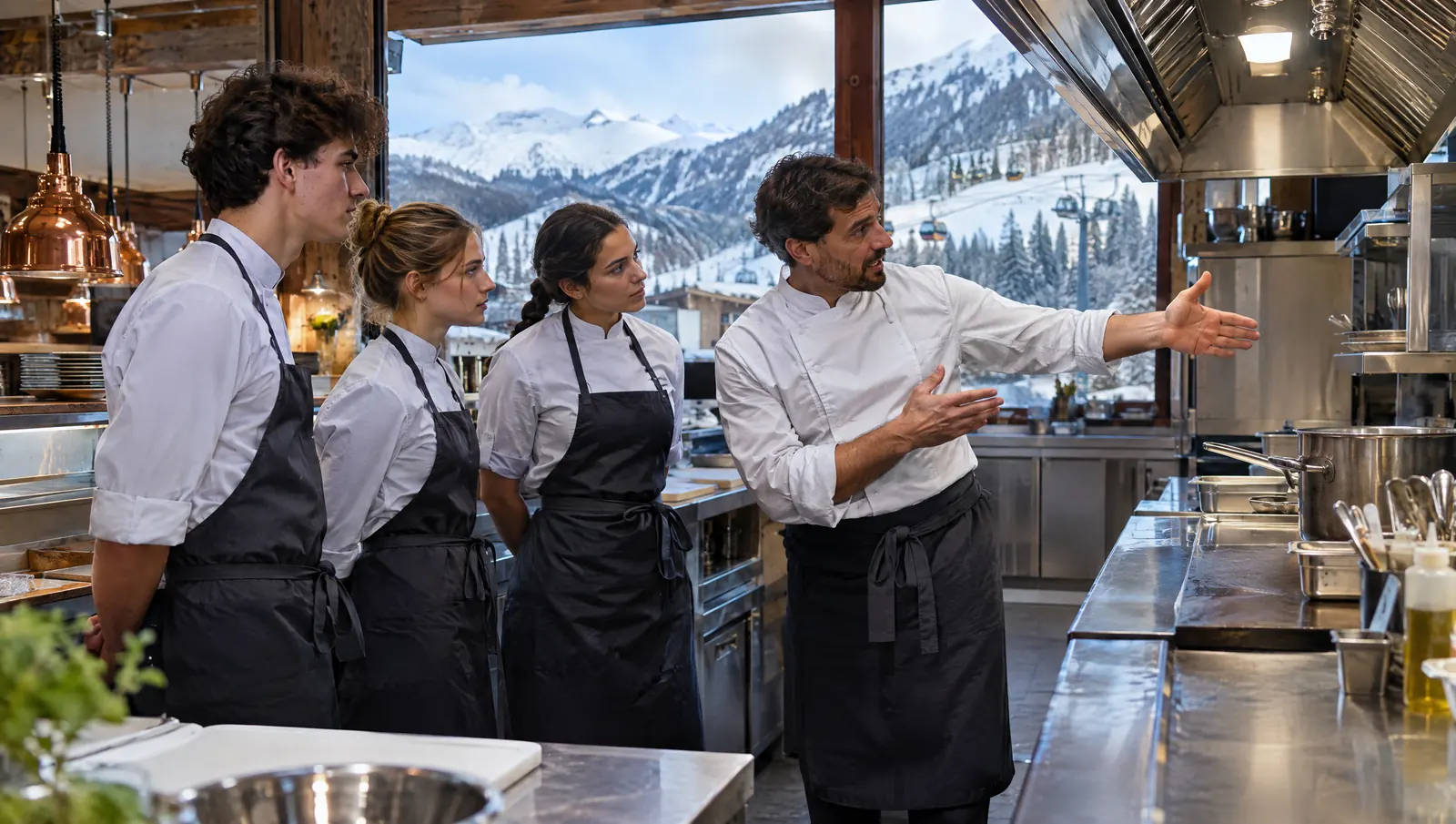
Christophe runs the kitchen of a 120-cover mountain restaurant. Tomorrow the resort opens. This morning three seasonal hires arrive: Leïna, a commis, Erwan, a dishwasher, and a second commis who has never worked at altitude. Their whites are new, folded the night before.
Christophe walks them round station by station: cold section, hot line, dish pit, dry store. He talks fast, with forty things on his mind. At 9:15, Leïna asks where the cold section sheets are. There aren't any: "I'll show you tomorrow." At 9:40, Erwan wants to know how to log in to the site tablet. Maud, the general manager, is on the phone with a supplier. Nobody knows his code.
The next day at lunch, four hundred skiers come in to eat. Christophe has no time to show anyone anything. Leïna watches the cook next to her and copies. Erwan strips the dishwasher the way he did at his last job. (Fictional scene and characters.)
Why a seasonal peak needs the same planning as an opening
Everyone arrives at once
One new hire blends into a settled team. Three or five in the same week change the team itself. There are no longer enough experienced people to answer everyone, and those people have their own station to run on opening day.
The volume is huge, and it comes back every year
In France, 63% of hiring declarations in the hotel, café and restaurant sector are for fixed-term contracts of less than a month (AKTO, the sector's training body, HCR monograph 2024). That counts contracts, not people: the same extra can sign several. For waiting staff alone, France's public employment service, France Travail, counts nearly 94,000 planned hires in 2026, around two in three of them seasonal (BMO 2026 survey). These are hiring intentions, not actual hires. But the message is simple: in a seasonal business, onboarding is a job you do every year.
What the season learned leaves with the season
In April or September, the seasonal staff leave, and what they found out goes with them: the sheet that was wrong, the trick for the Sunday dish pit, the product nobody could ever find. Next year, you start again with the same gaps. We look at this in the hidden cost of lost knowledge.
Before they arrive: what has to be ready
Anything that can be done before day one should be. Day one is too short.
- Set up access. Each seasonal hire gets an account, a role and a site. They should be able to log in to the site tablet with their own code on the first morning.
- Plan the end date now. A good tool lets you create access that expires on its own when the contract ends. If yours does not, put the date in the manager's calendar on the day you create the account.
- Send the hiring paperwork in advance. Contact details, documents, contract: whatever can be filled in remotely should not eat into the first morning.
- Prepare the welcome booklet. A short version for this site and this station: hours, uniform, staff meals, who to talk to. See the real problem with restaurant onboarding manuals.
- Write one short sheet per station. One page at most: the first tasks in order, the standards, a photo of the expected result. Not the house encyclopedia. What it should contain is covered in the modern restaurant job profile.
- Name the buddies. One experienced person per new hire for the first shift, chosen in advance and told about it.
- Publish the schedule early. Seasonal staff should know when they work before they arrive, not from a sheet pinned to the wall on the first morning.
For Saturday extras, the same list is shorter: access, the station sheet and a buddy. An extra who comes back every month keeps their access between shifts, and you close it when they stop coming.
The first shift, on one station with a buddy
The first shift works as a supervised first look, without trying to teach everything.
One station, not three
Leïna works the cold section with an experienced cook beside her. She does not move to the hot line at 1 p.m. because someone is missing. Switching stations mid-rush means learning everything again under pressure.
The buddy shows, the sheet reminds
The buddy shows the task once, at their own pace. The sheet then helps the new hire find the order and the standards without asking again. The buddy needs time for this: if they already have a full station, do not hand them a new hire on top. See how to train people without turning your best employee into a full-time trainer, and for how roles are split, the mentor and the assistant: who does what in training.
Finding-your-way questions stop going to the chef
"Where are the gloves?", "What do I do now?", "Which product goes on the worktop?": these questions need an answer that does not interrupt Christophe. That is the subject of "what do I do now?", for a single new hire. In season, the same answer serves five people at once.
What we expect of them, and what we do not ask
Saying both out loud reassures everyone. Seasonal staff know where their responsibility stops, and experienced staff know what stays with them.
| What we expect | What we do not ask | |
|---|---|---|
| First shift | Hold one station with a buddy, follow the sheet | Switch stations mid-rush |
| Allergens | Show the approved sheet, or fetch a manager | Answer a guest from memory |
| Temperatures | Take the scheduled reading, flag a problem | Decide alone whether a product is safe |
| Procedures | Know the ones for their station | Know every procedure in the house |
| Closing | Close with someone the first few times | Close alone on the first night |
| Questions | Ask as soon as they are unsure | Guess to avoid bothering anyone |
| End of season | Say what was missing from the sheets | Write the sheets instead of the chef |
The allergen line is not up for debate. Someone who started on Monday must never carry, alone, an answer that could send a guest to hospital.
The end of the season: capture the knowledge, close the access
The last week is often the most neglected. Yet it is the week that sets up the next season.
- Hold a twenty-minute debrief with each team. Three questions: what was missing from the sheets, what was wrong, what did you work out on your own.
- Fix the sheets that week. A comment noted in April and fixed in November is a lost comment. For the method, see a wrong step in a checklist: flag it, fix it for everyone.
- Record who was signed off on what. Skills validated by a manager stay on file. If Leïna comes back next winter, you know where she starts from.
- Close access on the day they leave. Not "when we get round to it". A forgotten login is an open door to the schedule, the procedures and the site information.
- Keep the season's list. Who came, on which station, with which buddy: that is the basis for next year's onboarding.
Common mistakes
- Doing everything on the first morning. Contracts, tour, uniforms, codes and training in one morning: nothing sticks, and opening day arrives.
- Writing sheets that are too long. A seasonal hire reads one page. Beyond that, they ask the person next to them.
- Giving everyone the chef's access rights "to save time". A commis does not need to see the whole team's schedule or employee records.
- Forgetting access at the end of the season. Six months later, nobody knows who can still log in.
- Never asking seasonal staff for their view. They are the ones who found the gaps in the sheets, with fresh eyes.
What to measure
- Time to the first task completed without help, for each seasonal hire, over their first three shifts.
- The number of sheets corrected after the end-of-season debrief. Zero corrections usually means nobody asked.
- The number of logins still open one week after contracts end. The target is simple: none.
Where Tsuno and San fit in
Tsuno brings together what a seasonal peak needs. The hiring file is filled in online, and contracts are generated from your templates and signed electronically. The welcome booklet is fitted to the role, the site and the language (drafted by AI, reviewed by you). The onboarding path sets out the steps in order, and skills are validated and dated by a manager. The schedule is published, everyone sees their shifts, and staff log in to the site tablet with a personal code. Access follows role and site, and recording a departure ends any open sessions. The details are on the features page. If your sheets do not exist yet, La Mise au carré, our on-site setup service, builds them with you before the season.
Our pricing principle points the same way: we charge per location, not per employee. A per-head bill would penalise the businesses that take on the most people every season.
Tsuno San, the intelligent voice assistant connected to this environment, takes the finding-your-way questions: next tasks, the station procedure, the checklist in progress. It acts within the seasonal hire's permissions and launches nothing without their confirmation; its voice interaction, San Voice, is available as a demo. San does not replace the buddy: it stops the chef from being the only place to find an answer on opening day.
Further reading
For a single new hire, read "what do I do now?". For a seasonal worker's first solo close, a closing checklist guided step by step. For how roles are split, the mentor and the assistant. And to judge a tool over a whole season, gadget or tool: the 60-day test. The pillar page Tsuno San, the work companion for frontline teams describes the tool as a whole. The same need comes up when a regular returns: back from leave and finding out what changed.
Key takeaways
A seasonal hire is useful from the first shift if their access, booklet, sheet and buddy are ready before they arrive. The season ends well when you fix the sheets with the people who are leaving, then close their access the same day.
Frequently asked questions
How do you prepare for seasonal staff arriving at a restaurant?
Before they arrive: set up their access, prepare the welcome booklet, write one short sheet per station and decide who will be their buddy on the first shift. Day one is for showing the work, not for filling in paperwork.
What can you ask of an extra on a Saturday night?
One clearly defined station, with a short sheet and a named buddy. You do not ask them to close alone, to answer allergen questions from memory or to know every procedure in the house.
How long does it take to train a seasonal restaurant worker?
There is no single answer. One shift is enough to hold a simple station alongside a buddy. Working a station on their own takes tasks that are shown, practised and then signed off by a mentor or manager.
What should happen to a seasonal worker's access when their contract ends?
It should be closed on the day they leave. A good tool lets you set access that expires on its own at the contract end date. In Tsuno, recording a departure ends any open sessions.
How do you keep what seasonal staff learned once the season is over?
Hold an end-of-season debrief with them: what was missing from the sheets, which steps were wrong, which tricks they found. Fix the sheets straight away so next season starts from a better version.
Keep reading

Pass it on without repeating
"What do I do now?": making a new hire useful from the first shift
A new hire is useful from the first shift when 'what do I do now?' has an answer without the chef: their next task, their station sheet, where things are.

Pass it on without repeating
Passing on a skill: what no AI will replace
Writing passes on where, when, which threshold, which step. A hand skill is shown and corrected hand on hand. AI's job is to free the mentor for that.

Pass it on without repeating
How to stop training new hires differently at every location
When every manager trains in their own way, two sites make two companies. Here is a shared path per role, with the coaching room that stays with the manager.