

A new hire becomes useful from the very first shift when the question "what do I do now?" has an answer that does not depend on the chef being in the room. That answer has three parts: their next task, the sheet for their station, and where to find what they need. All of it is prepared before they arrive, not in the middle of service.
Saturday, 10:15 a.m., in the dry store
Leo is nineteen. It is his first day as a commis in an eighty-cover brasserie. He has been given carrots to peel, and he is done. The head chef is out on the pavement taking a delivery, the sous-chef is deep in hot-side prep, a cook is cleaning the slicer. Leo has already asked twice what he should do next. He will not ask a third time.
So he goes into the dry store, tidies a box that did not need tidying, and waits. Twenty-five minutes go by. When the chef comes back: "You didn't set up the cold station trays?" Nobody had told him there were trays, where the list was, or where the labels were kept.
Leo is not slow. He is alone with a question whose answer lives in the head of someone busy. (Characters and venue are fictional.)
Why this one question is so expensive
New hires don't dare ask again
On day one, every question has a social cost. You do not want to interrupt a team that is running, and you do not want to be the one who never gets it. After two questions, many people would rather wait or guess. Waiting wastes time. Guessing causes mistakes.
The answer lives in someone's head, and that person is busy
In most kitchens, the order of the morning tasks is not written down anywhere. The chef knows it, so does the sous-chef, and the longest-serving porter knows part of it. Once those three are tied up, the new hire has no access to the information. The issue is not motivation: there is simply no source other than people.
Day one keeps coming back
In France, 63% of hiring declarations in the hotel, café and restaurant sector are for fixed-term contracts of less than a month (AKTO, the sector's training body, HCR monograph 2024, 2022-2023 data). That counts contracts, not people: the same casual worker can sign several. For a team, though, the effect is concrete: first days happen all the time. Recruitment is also tight: France's public employment service, France Travail, counts around 319,000 planned hires in hospitality for 2026, 44% of which employers expect to be difficult (BMO 2026 survey). Those are hiring intentions, not hires, but they show you do not always choose who arrives, or when.
The real cost never shows up on payroll
What a new arrival really costs is time taken from elsewhere: the manager interrupted ten times, the colleague who stops to show where the gloves are, prep running late. It is also the mistakes of the first days: a product stored in the wrong place, a missing label, a task done twice because nobody knew it was already done. None of these costs has its own line, which is why they get underestimated.
What the question should trigger
"What do I do now?" does not call for a speech. It calls for three specific things.
- Their next task, concrete and with a clear end point. Not "help out on cold", but "set up the six cold station trays, the list is on the sheet".
- The sheet for their station, as the house does it: the order of steps, the standards, what to check before saying "done".
- Where to find things: labels, gloves, the bin store, today's cleaning product, and who to tell if something is missing.
If those three answers exist somewhere outside the chef's head, the new hire keeps moving even when everyone is busy.
Method: the 5 first-day questions to prepare
Prepare these five answers once for each station. They will serve every new arrival.
- "What do I do now?" List the station's first tasks in order, for each part of the day (opening, before service, after service).
- "How do we do this here?" For each task, a short sheet with a photo of the expected result. The house version, not the catering-school one.
- "Where is...?" A list of useful locations: dry store, walk-in, cleaning products, label printer, first-aid kit.
- "I'm done, what next?" Fallback tasks that are always useful: restocking, cleaning a zone, prepping for the next station.
- "Who do I ask if I'm not sure?" The name of today's go-to person, and one rule with no exceptions: allergens, temperatures and safety are never guessed, you ask a manager.
To check your work, have the most recent hire read the answers. They know better than you what was missing.
The five questions at a glance
| New hire's question | Answer to prepare | Where it lives | If it is missing |
|---|---|---|---|
| What do I do now? | Station tasks, in order, by time of day | Station task list | They wait, or hide in the dry store |
| How do we do this here? | Short sheet with a photo of the result | Station procedure | They do it the way they learned elsewhere |
| Where is...? | Useful locations | Site information | They interrupt a colleague every time |
| I'm done, what next? | Fallback tasks | Station task list | They tidy boxes |
| Who do I ask? | Today's go-to person, critical-topics rule | Notice board and welcome sheet | They guess, sometimes about an allergen |
Common mistakes
- Telling them everything on the first morning. The whirlwind 9 a.m. tour is gone by 11. Answers available at the moment the question comes up work better.
- Relying on "just ask if you need anything". They will not ask a third time. The sentence mostly reassures the person who says it.
- Pairing the new hire with your best person without freeing up their time. Buddying is valuable, but your best cook should not become a help desk during their own service. See how to train people without turning your best employee into a full-time trainer.
- Writing sheets nobody reviews. An outdated sheet is worse than none: it gives the wrong answer with confidence.
- Confusing "did it once" with "knows how". The first shift is for discovery, not sign-off.
What to measure
- How many times the new hire interrupts the manager and colleagues during their first three shifts, noted by the go-to person. You are measuring the system, not the person.
- Time to the first task completed without help, over their first days.
- How many times you hear "nobody told me" during the first week.
Where Tsuno and San come in
Tsuno keeps procedures, tasks, checklists and site information in one place, so the five answers above have a natural home. If nothing is written down yet, La Mise au carré starts from your stations and routines to build that content with you.
Tsuno San is the intelligent voice assistant connected to that environment. A new hire can ask it "what do I do now?" and get their next tasks, the matching procedure, or a piece of information they need for their station, without waiting for the chef to come back in from the pavement. San only sees and does what that person can already see and do in Tsuno. If it needs to tick off a task, it prepares the action, the person confirms, and it is recorded. When the information does not exist, a good assistant says so and points to a person: that is the rule we are building San around. Voice interaction, San Voice, is available in demo; hands-free use is under exploration and testing.
There is a limit: San does not replace a mentor or training. It stops the chef from being the only place to find an answer. Techniques are still shown and corrected by people. That is the job of Tsuno Compétences: skills pathways built on your stations, hands-on practice on the job using the French AFEST workplace-training method, then observation and sign-off by a mentor or manager. San does not assess anyone. Signing off a skill stays a human decision.
Further reading
To see the bigger picture, start with the pillar page Tsuno San, the work companion for frontline teams, then read why an assistant must be able to say "I don't know". On onboarding, see how to reduce restaurant onboarding time without cutting corners and why new restaurant employees often say "nobody told me". And for the next step, how to know when a new restaurant employee is actually ready. The same need comes back for people returning to work: back from leave and finding out what changed since your last shift.
Key takeaways
A new hire who does not know what to do is not a bad hire: they are facing a question with no answer within reach. Prepare the five first-day answers once, make them available without bothering anyone, and leave people to do what only people can: show the technique and sign it off.
Frequently asked questions
How should you welcome a new restaurant employee on their first day?
Before they arrive, prepare answers to their first questions: what they do now, how things are done here, where things are, what to do when they finish and who to ask when unsure. Give them a named go-to person for the day.
Why don't new hires ask questions?
They do not want to bother a team in the middle of a rush, they worry about looking slow, and they have often asked the same thing once already. After two attempts, most people wait or guess.
What does a commis need to know on their first shift?
Their first task with a clear end point, the station sheet as the house does it, where equipment and products are kept, and one simple rule for critical topics: allergens, temperatures and safety are never guessed, you ask a manager.
Can an assistant replace a new hire's mentor?
No. An assistant can answer where-is-it questions and bring up tasks and procedures. A technique is shown, corrected and signed off by a person, on the job.
Do you need written procedures before using Tsuno San?
San relies on what already exists in Tsuno: procedures, tasks, checklists and site information. If nothing is written down, the La Mise au carré onboarding service starts from your stations and routines to build that content with you.
Keep reading

Pass it on without repeating
Seasonal staff and extras: ready from the first shift
A seasonal hire is useful from the first shift when everything is ready first: access, welcome booklet, short station sheets, a buddy, and a planned season end.

Pass it on without repeating
Passing on a skill: what no AI will replace
Writing passes on where, when, which threshold, which step. A hand skill is shown and corrected hand on hand. AI's job is to free the mentor for that.
Pass it on without repeating
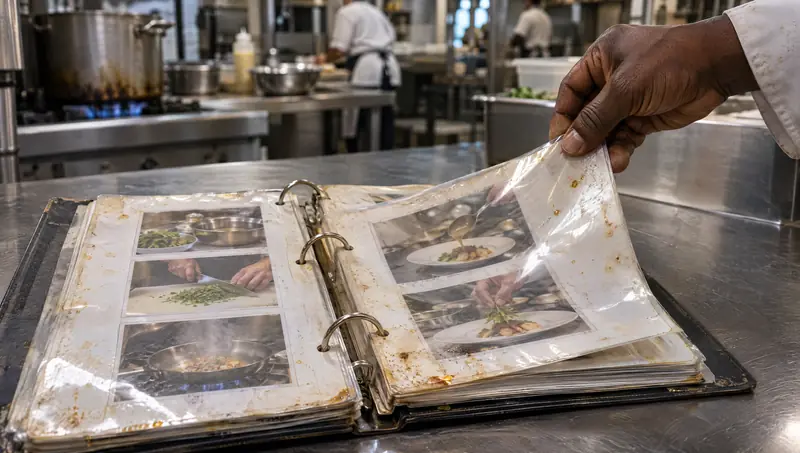
Sirha 2027: bring a page from your binder
At stand S.57, Sirha Lyon 2027, bring one page from your procedures binder. Together we look at what works by voice, what stays written and what is missing.