
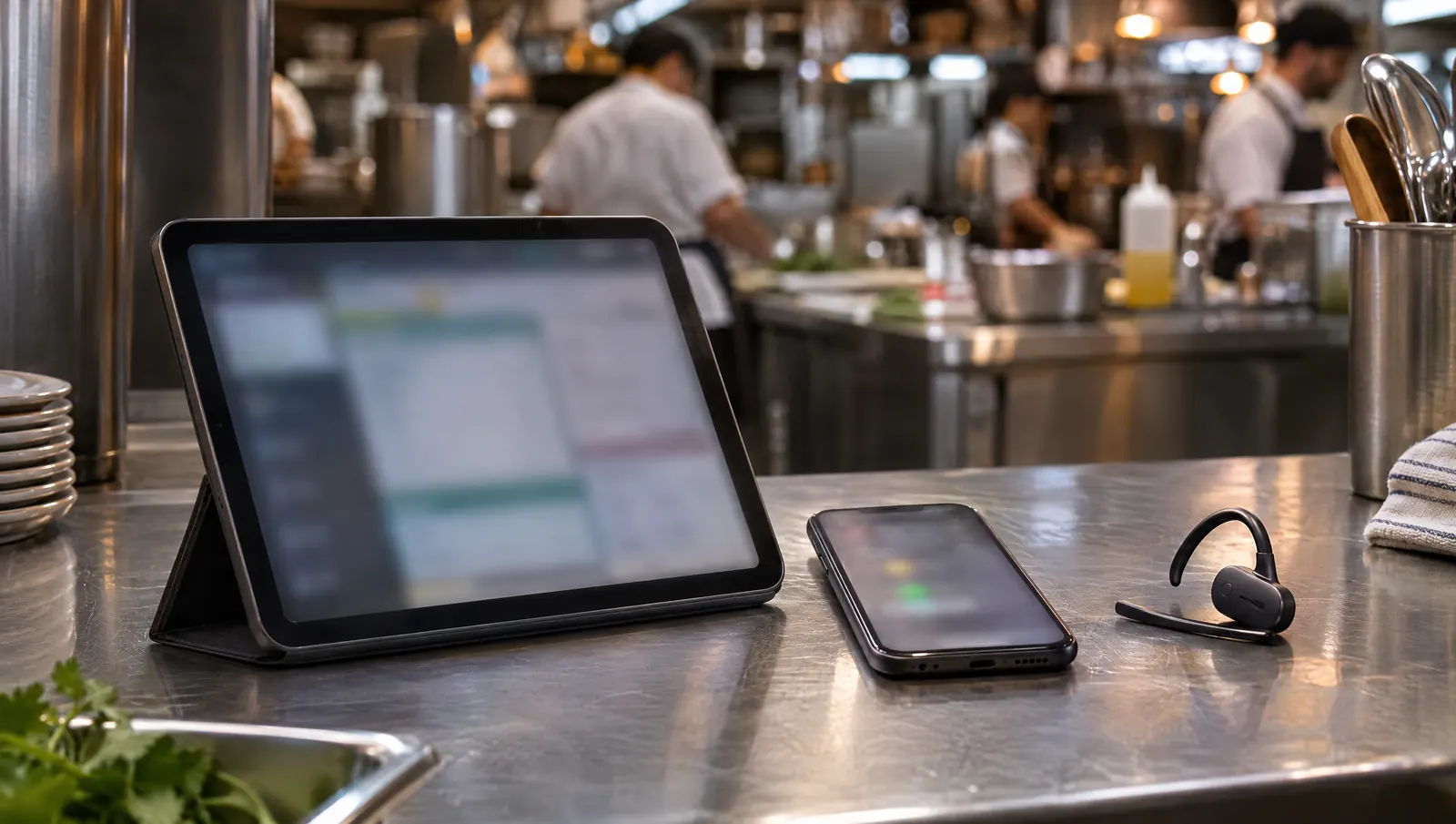
In a kitchen, each device has its job. A fixed wall tablet is for reading: recipe cards, checklists, temperature logs. The phone stays in your pocket, for your schedule and your break. A small dedicated device with an earpiece that leaves the ear open helps when your hands are full and the question is short. A closed headset is the one to avoid: it cuts people off from colleagues and alarms.
Thursday, 9:15 a.m., the equipment order
Gabin runs a forty-cover kitchen. He wants the team to stop shouting "Does anyone know where the white stock recipe is?" across the room. On his desk sit three options: a second tablet for the wall of the cold station, the idea that everyone just uses their phone, and an ad for call-center headsets.
Lisa, his sous chef, has her hands in a tub of vegetables. She listens and asks one question: "And when the oven timer goes off, will I hear it with your headset?"
Lisa's question is the right one. In a kitchen, hardware is judged on what it does to hands, ears and service, far more than on its spec sheet.
(Gabin, Lisa and their kitchen are fictional.)
Why office hardware does not survive a kitchen
Hands are rarely free and rarely clean
Flour, grease, water, cleaning chemicals, gloves. Everything you touch gets dirty, and everything dirty travels. A screen you have to touch to get an answer costs you a hand wash, or a contamination.
Ears are already working
A kitchen talks all the time: the pass calls tickets, a colleague shouts "hot behind", a timer goes off, a walk-in probe sounds an alert. Anything that blocks the ear removes part of that information, and some of it protects the team from a burn or a collision.
Hardware gets dropped, gets wet and changes hands
A screen next to the dish station ends up wet. A device clipped to an apron ends up on the floor. And what belongs to everyone gets cleaned by no one. We cover that last point in hygiene of shared equipment in restaurants.
The four options, criterion by criterion
The fixed wall tablet
This is the right tool for reading. A recipe card, an opening checklist, a log to enter and reread: anything with a shape reads better on a fixed screen at eye level, always in the same place. It shares well, as long as each person identifies themselves: in Tsuno, the venue tablet has a shared mode where everyone works with their own code. Its limit: you have to walk over to it, and touch it.
The pocket phone
It is already there, and that is its only real argument. For checking a schedule or rereading a recipe card on a break, it works fine. At a station it raises three problems: it comes out of the pocket with dirty hands, it goes back into the pocket with whatever it picked up, and it belongs to the employee. Nobody should have to use their personal phone to do their job.
The small dedicated device with an open earpiece
This is the option built for busy hands. The device stays on you, you ask quietly, the answer comes to your ear, and you touch nothing. The choice of earpiece matters: an open-ear model, sitting against or in front of the ear without plugging it, lets you hear the kitchen. It also has to be light, or it ends up in a pocket within an hour. Its limit: it is only for short questions, and it should be personal.
The closed headset
It is made for a quiet office or a call center. In a kitchen it isolates: you no longer hear the pass, the colleague coming through with a sheet pan, or an oven alarm. It is hot, it slips with sweat, and it can be seen from across the room. We advise against it in a kitchen, whatever it costs.
The decision table
| Criterion | Fixed wall tablet | Pocket phone | Dedicated device and open earpiece | Closed headset |
|---|---|---|---|---|
| Hands | You have to touch it | You have to take it out and touch it | Nothing to touch for a short question | Nothing to touch |
| Noise | Readable whatever the noise | Readable, but a small screen | Less reliable under the hood at full rush | Blocks noise, and everything else |
| Hygiene | Smooth surface, easy to wipe | Goes from pocket to prep counter | Personal, to be cleaned daily | Foam pads are hard to clean |
| Safety (alarms, colleagues) | No impact | Can distract | One ear stays open | Blocks alarms and colleagues |
| Breakage | Mounted, out of splash range if well placed | Frequent drops at the station | Expect some: it travels with the person | Fragile, gets put down anywhere |
| Charging | Plugged in all the time | Up to the employee | Once a day, stored in the same spot | Once a day |
| Sharing | Yes, with one code per person | No, it is personal | Device can be reassigned, earpiece stays personal | Not recommended |
| Cost | One screen per work area | Nothing for the employer, but it is not work equipment | One kit per equipped person | One kit per person |
| Image in front of guests | Invisible if it stays in the kitchen | Poor on the floor | Discreet, keep it back of house | Poor: it looks like a call center |
| Best use | Read, tick, reread | Schedule, breaks, off station | Short question, busy hands, outside the rush | None in a kitchen |
This table sums up our field criteria; it is not a lab test. Every kitchen weighs these lines its own way. Two do not move: one ear stays open, and you do not talk to your earpiece in front of a guest.
How to choose for your own kitchen
- Start from moments, not devices. Note when hands are full: prep, dish station, deliveries, closing.
- Put a fixed screen where people read first. A tablet in the right place, at eye level and away from the sink, settles a lot of questions.
- Add voice only where the screen forces a hand wash for a one-sentence question.
- Equip volunteers, and keep everything voice allows available on screen (see San on screen, San by voice).
- Assign each earpiece to one person. The device can be reassigned; what sits against the ear should not be.
- Set up a fixed charging and storage spot, outside the production area.
- Count the full cost: purchase, covers, replacement after a drop, cleaning time. The sticker price alone is misleading.
Common mistakes
- Choosing from a demo in an office. The real test happens at the dish station and during prep, with real questions. We explain why in why we test in the kitchen before we sell.
- Buying closed headsets "so the noise does not get in the way". What gets in the way of voice also protects the team: calls and alarms have to get through.
- Relying on everyone's personal phone. It is free for the employer, but it is neither hygienic at a station nor fair to the employee.
- Putting a single tablet at the pass for the whole kitchen. It becomes a bottleneck, and people stop checking it.
- Leaving the equipment lying around. Without a charging spot, it is flat by 11 a.m. and dirty by 2 p.m.
- Expecting voice to help during the rush. Noise and pace do not allow it: we come back to this in kitchen noise and why voice is not always the answer.
What to measure
- The number of hand washes triggered just to look something up, over one prep shift, before and after the change.
- The share of the team still using the equipment after two weeks, without being reminded.
- The number of times an alarm or a call from the pass was missed. It should stay at none.
What Tsuno is preparing, without overselling it
Tsuno San is the smart, voice-enabled assistant for frontline teams. On screen, you ask Tsuno questions in plain language, from Tsuno or from your usual AI assistant (ChatGPT, Claude, Mistral), with the same permissions. It is the same San on screen and by voice, and it only sees and does what the person can already see and do in Tsuno.
For voice, the hardware we are preparing is simple: a small dedicated Android device and a light earpiece. Each person opens their session with the venue code and their PIN, so the session is personal even when the device changes hands. San Voice is available as a demo; San Audio, the hands-free experience, is under exploration and testing, not a shipped product (see where San stands).
If your team mostly reads recipe cards, a well-placed tablet is enough. If it spends its mornings with hands deep in prep, the demo shows where voice helps and where it does not. Details are on the Tsuno San page.
Further reading
To know when to speak and when to read, see San on screen, San by voice: when to use which. For the moments where voice really helps, read why talk to your tools when your hands are full. For the view of people who are on their feet all day, what voice changes for people who work on their feet. And for keeping all that equipment clean, hygiene of shared equipment in restaurants. This equipment choice belongs to the future of work in hands-on jobs. For comfort over a whole shift, read eight hours wearing equipment, and for the budget, the real cost of a voice tool in a restaurant.
Key takeaways
In a kitchen, a fixed tablet is for reading and a light earpiece helps busy hands, as long as one ear stays open. A closed headset cuts the team off from alarms and colleagues: it has no place behind the pass.
Frequently asked questions
What is the best device for checking procedures in a kitchen?
There is no single answer. A fixed wall-mounted tablet is best for reading a recipe card or a checklist. A small dedicated device with a light earpiece helps when your hands are full and the question is short. A personal phone will do in a pinch, but it does not belong on the prep counter.
Can kitchen staff wear a closed headset?
It is not recommended. A headset that covers both ears cuts people off from colleagues, calls from the pass, timers and alarms. In a kitchen, at least one ear should stay open.
Should employees use their own phones for work?
To check a schedule or a recipe card on a break, yes, if they want to. For working at a station it is a poor basis: the phone comes out of a pocket with dirty hands, it does not belong to the business, and nobody should be required to use it.
Can an earpiece be shared between several employees?
It is best avoided. Anything that goes in or against the ear should be assigned to one person. If sharing cannot be avoided, it needs cleaning between users and disposable covers.
What hardware is Tsuno preparing for voice?
A small dedicated Android device and a light earpiece. Each person opens their session with the venue code and their PIN. The San Voice interaction is available as a demo; the San Audio hands-free experience is under exploration and testing.
Keep reading
AI and tools
General voice assistant or a companion that knows your workplace?
For a timer, a consumer voice assistant is enough. For your recipes, permissions and team, you need a work companion. An 8-point comparison.

AI and tools
How to test a voice assistant in a kitchen
Thirty real questions from your team, under the hood and in the quiet, several voices, allergen traps, dictated numbers, then two weeks and two months of use.

AI and tools
Kitchen noise, and why voice is not always the answer
Hood, dish station, fryer, music: in the noise, voice is often the wrong choice. What helps, when to switch to the screen, and how to protect hearing.