
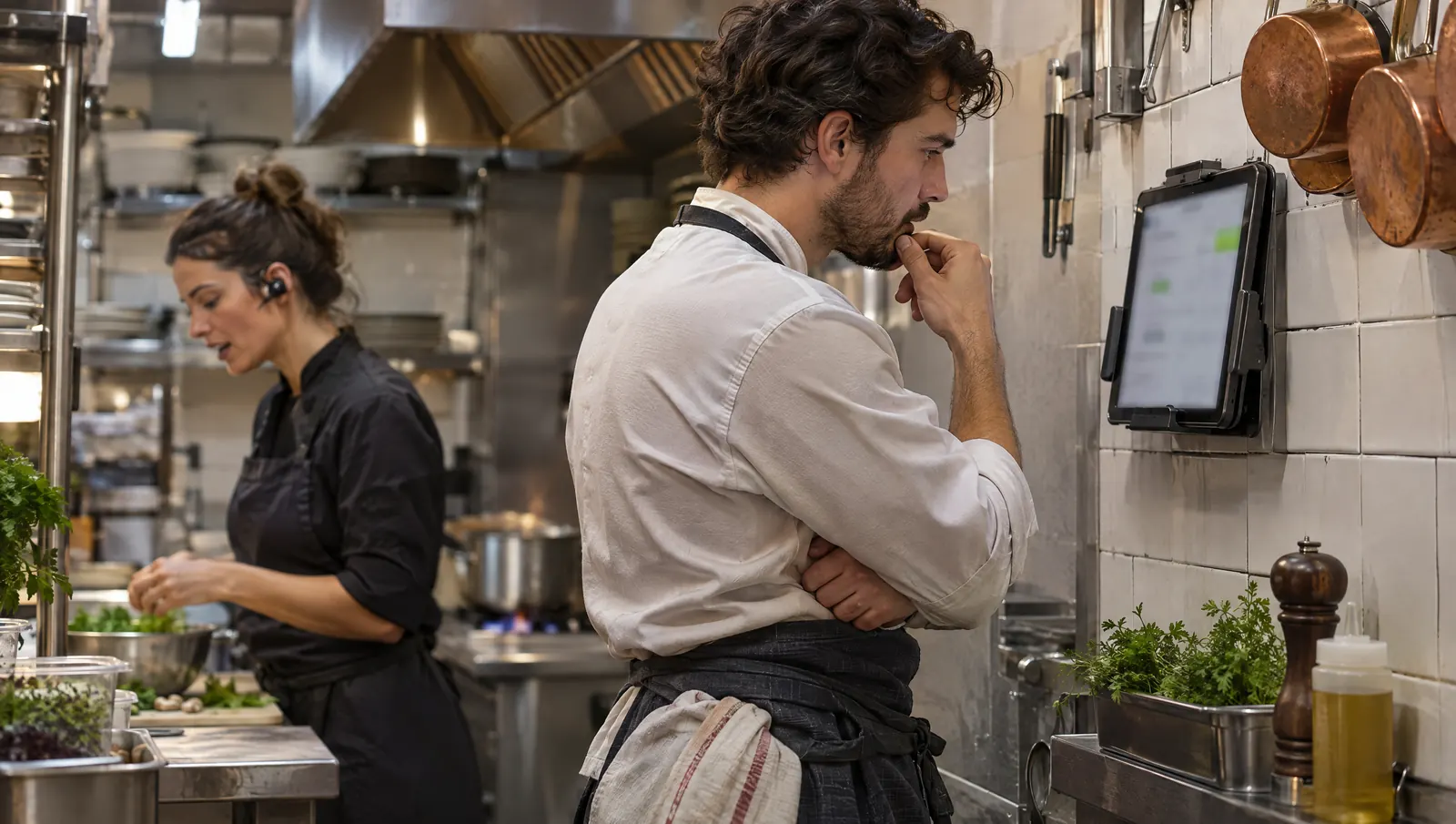
Use San by voice for a short question when your hands are full, in the kitchen, at the dish station or in the storeroom, outside the rush. Use the screen for anything you need to read, reread or check, for anything about you personally, and on the floor. During service, neither: the information should already be at the pass. When in doubt, the screen wins, and it should always let you do everything voice does.
Tuesday, 10:20 a.m., during prep
Tarik runs the hot station. He has to start a stock he has not made since the menu changed. He wipes his hands, walks to the wall tablet and opens the recipe: fourteen lines, weights, a reduction time. He reads it twice.
Behind him, Anne is cutting vegetables, hands in the tub. She asks quietly: "What's left on my prep list?" The answer fits in one sentence: the shallots, then labeling yesterday's containers. She never puts her knife down.
At 10:40, Margaux comes in from the floor. She wants to know whether she has any leave left for next month. She does not feel like asking out loud in front of the whole brigade. She will check on her phone during her break.
Each of them chose differently, and none of them got it wrong.
(Tarik, Anne, Margaux and their restaurant are fictional.)
Why there is no single right answer
Voice and screen are good at different questions
Voice is made for short answers: a task, a step, a quantity left. The screen is made for things that have a shape: a recipe, a list, a table, a temperature curve.
The same station changes with the time of day
The same commis has her hands full at 10 a.m. and free at 2:30 p.m. The same kitchen is quiet during prep and deafening during the rush. The choice does not depend on the station alone, it depends on the moment.
Speaking means speaking in front of others
A question asked out loud can be heard. In a kitchen, there is almost always someone within six feet. That is fine for "where are the sixth-pans?" It is not fine for "how many hours do I have left this month?"
Four questions to decide
Before you talk to San, ask yourself these four questions, in order. As soon as one answer points to the screen, use the screen.
- Can a guest hear me? If so, screen, out of sight. Voice stays back of house.
- Is this about me or a colleague? Hours, leave, a shift swap, a problem with someone: screen.
- Is it a critical topic? Allergens, temperatures, a cleaning chemical, safety: screen, so you see the validated, dated sheet exactly as it is written.
- Are my hands full, and does the answer fit in one sentence? If so, voice is the right choice. Otherwise, screen.
There is a fifth answer, less common: neither. During a dangerous task or while plating for the pass, you do not look anything up. You do the job, or you ask a colleague.
The guide, moment by moment
| Moment and station | Voice | Screen | Neither |
|---|---|---|---|
| Arrival, start of shift | Rarely: your hands are still free | Clock in on the tablet with your code, open My schedule and today's feed | While changing into your whites |
| Prep, mise en place | "What's my next task?", "What's left?" | Read a recipe, see the whole day's prep at a glance | During a knife or slicer task |
| Rush, hot line | Best avoided: noise and pace | What is already displayed at the pass | While sending plates: colleagues talk to each other |
| Dish station, cleaning | "How do I take the slicer apart?", step by step | Dosage and precautions for a cleaning chemical | While handling a corrosive product |
| Storeroom, deliveries | "What's left to put away?" | Photograph the delivery note, enter and reread a reading | Holding the walk-in door open for a long conversation |
| Closing | Work through the checklist, step by step | Reread and confirm the readings before leaving | While shutting off gas or power: one task at a time |
| Office, break | Pointless: you are sitting down | Schedule, leave, swaps, reports, or from your usual AI assistant | Nothing |
| Floor, counter | No | Yes, out of the guests' sight | While taking an order |
This table describes our usage principles. Every team adjusts it to its own kitchen; only the floor row never changes.
Why voice does not belong on the floor
On the floor, a server talking into an earpiece raises two problems. The first is image: the guest wonders whether they are being listened to, or talked about. The second is privacy: at the table, people talk about their work, their health, their families, and those conversations have no business being near a work microphone.
This is a usage principle: San by voice is designed for back of house, the kitchen, the dish station, the storeroom. On the floor, the screen is enough, checked out of sight. For the legal framework of a microphone at work in France, see a microphone at work: what the law says in France.
What if you cannot, or would rather not, speak?
Some people are hard of hearing. Others stammer, have an accent the tool understands less well, or simply have no wish to talk to a machine in front of their colleagues. A voice-only interface would shut them out, and they are exactly the people a frontline tool should serve.
So the rule is simple: everything San allows by voice must remain possible on screen, with readable text, with no loss of access. Nobody should be made to wear an earpiece. Someone who prefers the screen keeps the same permissions and gets the same answers, actions included. For teams working across several languages, see non-native speakers in the kitchen: understanding without shame.
What you say out loud, your colleagues hear
With an earpiece, the answer stays discreet. The question, though, carries across the whole kitchen. Before you speak, ask yourself whether you would ask the chef the same thing out loud, in front of everyone.
A few topics are better handled on screen, for that reason alone:
- Your hours, your balance, your leave.
- A shift swap request, especially if the reason is personal.
- An incident involving a colleague.
- Anything to do with your health, which Tsuno refuses to record about an employee anyway.
On the tool side, the rules do not change with the interface. San acts within the permissions of the person using it: by voice or on screen, it only sees and does what that person can already see and do in Tsuno. And San does not analyze emotions or stress in a voice. That is not only a choice: under EU law, the AI Act (Regulation (EU) 2024/1689, Article 5) has banned systems that infer people's emotions in the workplace since February 2, 2025, except for medical or safety reasons. The other red lines are in what San never does.
And when San needs to act?
Ticking off a task, reporting a breakdown: by voice or on screen, San prepares and waits for a confirmation (we cover this two-step rule separately). By voice, you hear the summary; for a number, a good tool repeats what it heard before saving it, and that is the rule we are building on. For a temperature reading or a list longer than three lines, rereading on screen before you confirm is still the best habit.
Common mistakes
- Trying to do everything by voice. A recipe, a list, a table are meant to be read. Voice is for short questions.
- Judging voice on the rush. It is the worst moment to try it, and not the one it is designed for.
- Asking a personal question out loud. Even if the answer stays in your earpiece, the whole kitchen hears the question.
- Making the earpiece mandatory. A tool that is imposed gets worked around, and the screen has to be enough for those who do not want one.
- Confirming a number by voice without hearing it back. A misheard reading is worse than a missing one.
What to measure
- The share of questions asked by voice and on screen, by moment of service, over two weeks. If voice goes up during the rush, something is missing at the pass.
- The number of people who use only the screen, and whether they really have access to everything. They should lose nothing.
- Personal questions asked out loud, as reported by the team. They tell you the rule has not been explained well.
Where San stands, on screen and by voice
There is only one San. Tsuno San is the intelligent voice assistant for frontline teams, connected to the Tsuno environment: procedures, tasks, checklists, routine checks, equipment and site information. On screen, you ask Tsuno questions in plain language, from Tsuno itself or from your usual AI assistant (ChatGPT, Claude, Mistral), with the same permissions.
On the voice side, San Voice, the voice interaction, is available in demo. San Audio, the hands-free experience that would make voice truly useful with your hands in a tub, is under exploration and experimentation: it is not a shipped product. The hardware we are preparing is minimal, a small dedicated Android device and a lightweight earpiece, and each person opens their session with the location code and their PIN.
If your team works mostly on the floor, the screen is enough. If it spends its mornings on prep, at the dish station or in the storeroom, the demo will show you where voice helps, and where it does not. The details are on the Tsuno San page, and the online demo lets you try the screen right away.
Further reading
To understand why voice matters when your hands are full, read why talk to your tools when your hands are full. For an example of a question that belongs on the screen, see swapping a shift without calling the boss. For a moment where voice really helps, the morning opening, guided step by step. And for the big picture, the pillar page Tsuno San, the work companion for frontline teams.
Key takeaways
Voice is for short questions, hands full, back of house and outside the rush; the screen is for reading, checking, asking about yourself and working the floor. When in doubt, use the screen: it should always let you do everything voice does.
Frequently asked questions
When is it better to talk to an assistant than to look at a screen?
When your hands are full and the question needs a short answer: your next task, the next step on a checklist, what is left to put away. If the answer is long, needs rereading or concerns a critical topic, the screen is better.
Can you use a voice assistant on the floor or at the counter?
It is not recommended. Guests wonder whether they are being listened to, and the conversations of people at their tables have no place in a work tool. On the floor, check the screen out of sight.
Can everything you do by voice also be done on screen?
It should be. Someone who is hard of hearing, stammers, speaks another language or would rather not speak must keep exactly the same access on screen. Voice is an option, never an obligation.
Which questions should you avoid asking out loud at work?
Anything about you personally or about a colleague: your hours, a leave request, a shift swap, an incident involving someone. The answer can stay discreet, but the question can be heard. Those topics belong on the screen.
Does voice work during the rush?
Noise and pace do not lend themselves to it. During service, the information people need should already be displayed at the pass, and colleagues talk to each other. Voice is for before and after the rush.
Are San Voice and San Audio available?
San Voice, the voice interaction, is available in demo. San Audio, the hands-free experience, is under exploration and experimentation. Using San on screen does not depend on either.
Keep reading

AI and tools
Where San belongs in a restaurant, and where it does not
San by voice belongs in the back: storeroom, walk-in, dish station, prep, kitchen outside the rush. Pass, floor, office, rush: screen. Locker room: never.
AI and tools
General voice assistant or a companion that knows your workplace?
For a timer, a consumer voice assistant is enough. For your recipes, permissions and team, you need a work companion. An 8-point comparison.
AI and tools
How to test a voice assistant in a kitchen
Thirty real questions from your team, under the hood and in the quiet, several voices, allergen traps, dictated numbers, then two weeks and two months of use.