
Opening alone early in the morning means handling the alarm, the readings, the delivery and prep with nobody to ask when something unexpected happens. A step-by-step guided opening gives the next step in the right order, recalls the priorities the restaurant wrote down in advance and knows what to do when a fridge goes above its threshold. It does not replace the opener's judgment: it spares them from deciding alone what had already been decided.
Thursday, 6:45 a.m., key in the door
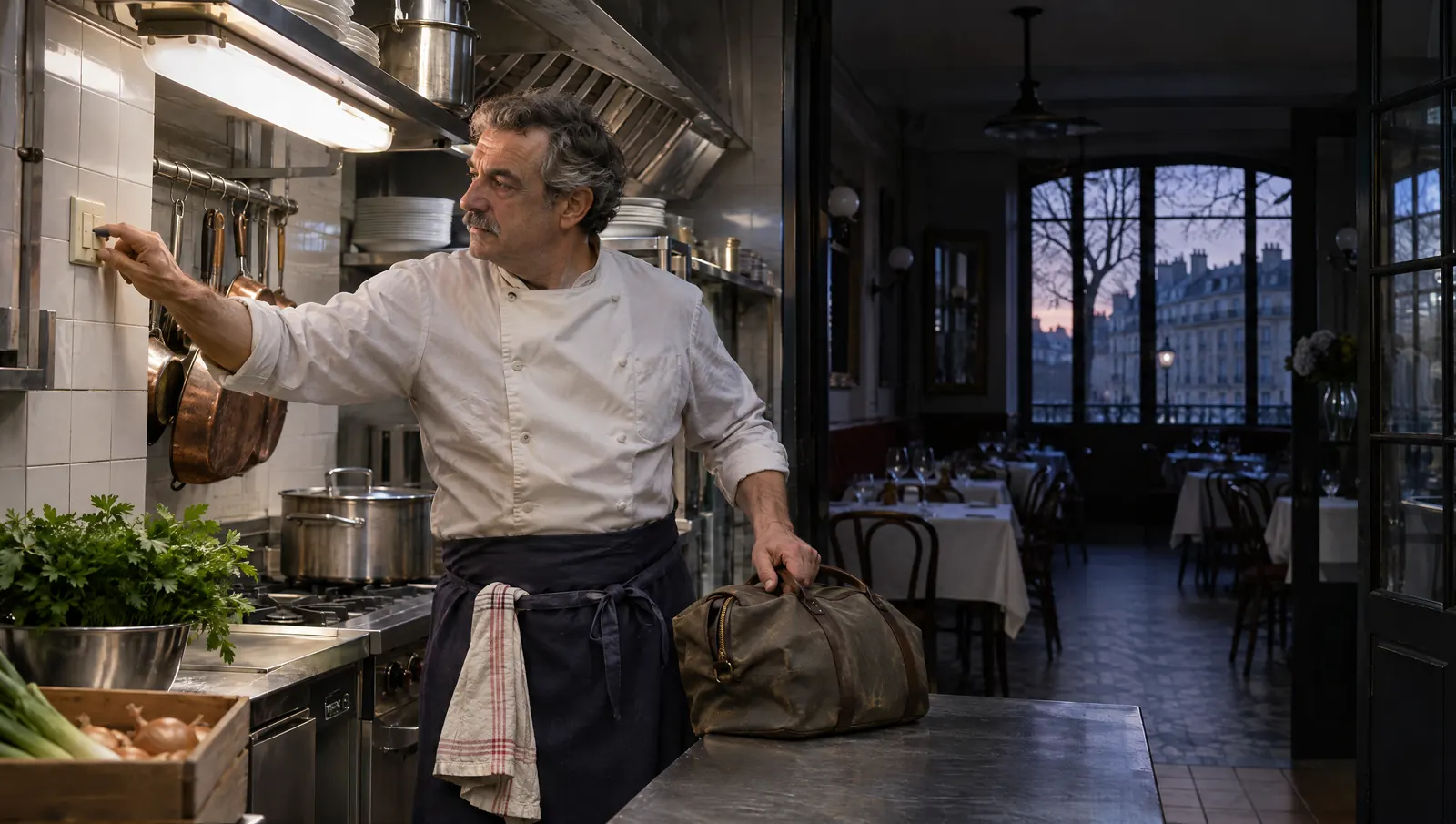
Baptiste is fifty-two and has thirty years in kitchens behind him. Three weeks ago he joined a neighborhood brasserie, and this morning, for the first time, he is the one opening. Théo, the head chef, gets in at 9:30. The sous-chef is on leave. The dining room is still dark.
He turns off the alarm, switches on the kitchen lights, puts his bag down. On the site tablet, he asks: "What's left on the opening checklist?" San answers: "Ten items. First: take the walk-in cooler reading." Baptiste knows the task. What he does not know yet is how this particular kitchen does things.
At 7:05, the fresh produce driver rings at the back door. He was due at 7:30. Baptiste has done two readings out of four. "The delivery's here, what do I do first?" San shows the instruction Théo wrote: finish the reading in progress, check in and put away the fresh goods, then go back to the readings. Baptiste photographs the delivery note, the tool flags a case of cream missing compared with the order, and he puts everything away.
At 7:25, he picks up again: "Where was I?" Third reading, the prep fridge: 7 °C, above the threshold set for that unit. He enters the value. The site's managers are alerted. He asks for the instruction for this case, and San shows the restaurant's "fridge out of range" sheet: move the prepared items to the walk-in, note the time, throw nothing away without a manager's say-so. He does it, then moves on to prep.
At 9:30, Théo walks in. He already knows what happened, from the alert and the history. Nobody called him at 7:10. (Scene and characters are fictional.)
Why opening alone is a fragile moment
Everything happens at once, and out of order
Opening is not a calm list. The alarm has its minute, the driver has a slot he does not always keep, readings must be done before anyone touches the products, and prep has to be ready for service. When these constraints collide, someone has to choose, and the first person in chooses alone.
The order lives in the chef's head
In many kitchens, the rule "the delivery comes before prep, but not before the reading in progress" is written nowhere. The chef knows it, so does the sous-chef. Baptiste, for all his experience, does not know this kitchen's version yet. His experience will give him a sensible answer. Not necessarily the house answer.
The first one in is not always the usual opener
Leave, sickness, a new hire, seasonal cover: the opening changes hands more often than people think. Each time, the opener rediscovers the small rules of the place. It is exactly the situation described in "What do I do now?": making a new hire useful from the first shift, at 6:45 a.m.
At that hour, calling someone has a cost
Waking the chef because a delivery is early? People hesitate. So they decide alone, or they wait. Both can end badly: fresh goods left on the sidewalk, a reading forgotten because someone was interrupted.
How to guide an opening step by step
For what the list should contain, see the opening checklist people actually use. What concerns us here is how the opener moves forward when nothing goes to plan.
- Start with what cannot wait. Access, alarm, lights, then the cold storage readings. A failing fridge changes the whole morning: you need to know before taking out a single product.
- Give one step at a time. The opener asks what is left, the tool gives the next item, in the order of the route.
- Write priorities as "if… then" before they are needed. "If the delivery arrives during readings, then…" A rule written the day before beats a decision made at 7:05.
- Restart from the real state. After the delivery, "where was I?" must get an answer based on what is ticked.
- Treat an out-of-range fridge as an event, not a tick. Record the real value, apply the written instruction, and the person in charge is alerted.
- Show the instruction, do not invent it. If the restaurant has written nothing for a case, the tool says so and tells you who to contact. We explain that choice in why an assistant must be able to say "I don't know".
- Leave the decision to a person. Keeping or discarding a product, calling a refrigeration engineer, pushing back a prep: the tool recalls the rule, it does not decide for the manager.
Point 3 often gets skipped, yet everything else depends on it: a step-by-step guide can only recite what has been written.
Morning surprises, and what the opener needs to find
| Surprise | Written priority (example) | What the tool shows | Who is alerted |
|---|---|---|---|
| Early delivery | Finish the current reading, check in and store fresh goods, resume the list | The instruction, then the step where you stopped | Nobody, unless the order does not match |
| Discrepancy at delivery | Note it, do not refuse alone unless a product is non-compliant | The delivery note and the gap with the order | Whoever handles ordering |
| Fridge above threshold | Record the value, move the products, discard nothing without approval | The "fridge out of range" sheet | The site's managers |
| Equipment will not start | Follow the equipment sheet, report it | The procedure and the repair contact, if written | The manager, through a confirmed report |
| Question with no written answer | Do not improvise on a critical topic | "This isn't written down", and who to contact | The person named |
The priorities in the second column are examples. Every kitchen writes its own, and that work is what makes guidance useful.
The out-of-range fridge, the moment that matters
This is when an opener on their own most needs backup, and a few habits must hold whatever the hour.
First comes the real value. Not a rounded number, not "I'll check again in ten minutes". An out-of-range reading recorded as it is protects the opener, the team and the guest. Our piece on temperature checks that are completed and still useless shows what happens when this habit slips.
Then the written instruction. Move, isolate, note the time: what the restaurant decided calmly, in advance, applies at 7:25 without debate.
That leaves alerting someone, without waking anyone for nothing: a notification to the site's managers is often enough. The manager then decides whether to call, come in, or trust the instruction.
Common mistakes
- Doing prep before the readings. You have already taken products out of a fridge whose temperature you do not know.
- Leaving priorities unwritten. "You'll see, it's obvious" is no help to someone opening this kitchen for the first time.
- Ticking a reading "to do later". A reading ticked without a value looks like a reading done. It is not.
- Assuming an experienced opener needs no guidance. He knows how to open a kitchen, not necessarily this one.
- Asking the tool to decide. Keeping or discarding a product stays a manager's decision, made with the instruction in front of them.
What to measure
- The number of openings where the checklist was interrupted and then completed. A list abandoned after the delivery points to a badly written priority.
- The time between an out-of-range reading and the recorded action. It tells you whether the instruction is known and applied.
- Morning questions with no written answer. Each one is an instruction to write before the next opening.
Where Tsuno and San fit in
Tsuno already provides the building blocks of an opening: checklists with templates, completion on a tablet and history; temperature readings per unit, with thresholds, and the site's managers alerted when a reading is out of range; delivery checks with a photo of the delivery note, assisted reading and discrepancies with the order flagged; procedures and documents stored by site. It all works on the site's shared tablet, each person with their own code.
San makes these blocks available by voice or on screen: "what's left on the opening checklist?", "what's the instruction if the fridge is out of range?". It answers from what the restaurant has written, and a report it drafts waits for Baptiste's confirmation before it goes anywhere.
The voice version, San Voice, can be seen in a demo; hands-free use (San Audio) is still being tested. A restart that reminds you of the interrupted step on its own after the delivery, without being asked, is part of what a good tool should do, and part of what we are working on. The Tsuno San page presents the assistant, and the features page details checklists, readings and delivery checks.
Further reading
For what goes on the list, see the opening checklist people actually use. For a new hire's first days, read "What do I do now?". The same flow at night is described in a closing checklist guided step by step. And for the bigger picture, the pillar page Tsuno San: the work companion for frontline teams.
Key takeaways
A guided opening gives the next step, recalls the priorities written the day before and makes sure an out-of-range fridge is followed by an instruction applied and a manager alerted. The opener is still alone at 6:45, but no longer has to guess the house rules.
Frequently asked questions
In what order should you open a restaurant when you are alone in the morning?
Access and security first, then the cold storage readings, then anything with a fixed time such as the delivery, and finally prep. Readings come before prep because a failing fridge changes the rest of the morning.
What should you do if the delivery arrives before the readings are finished?
Follow the rule the restaurant wrote down in advance. Usually you finish the reading in progress, check in and put away the fresh goods, then pick up the checklist where you left it. If no rule is written, that is the first thing to fix.
What should you do if a fridge is above its threshold at opening?
Record the reading as it is, apply the restaurant's written instruction for that case, and alert the person in charge. In Tsuno, a reading outside the threshold alerts the site's managers. The decision about the products belongs to a manager, not to the tool.
Can an assistant help when nobody else is there in the morning?
It can give the next step, show a procedure and recall an instruction, provided the restaurant has written them. When the answer does not exist, a good assistant says so and tells you who to contact, instead of making something up.
Does Tsuno San work by voice during opening?
San Voice, the voice interaction, is available in demo. San Audio, the hands-free experience, is under exploration and testing. San can also be used on screen, on the site's shared tablet.
Keep reading
Hygiene and compliance
A closing checklist guided step by step
Closing alone for the first time is manageable when the tool gives the next step, logs each "done" and picks up exactly where you left off.
Hygiene and compliance
An outdated procedure is more dangerous than a missing one
A missing procedure makes people ask; an outdated one gets followed with confidence. Date every sheet, name an owner, take old printed copies down.
Hygiene and compliance
HACCP checks with busy hands: no more greasy pen
A useful temperature check is logged when you read the thermometer, not that evening from memory. Saying it aloud keeps the real time, the person and next steps.