
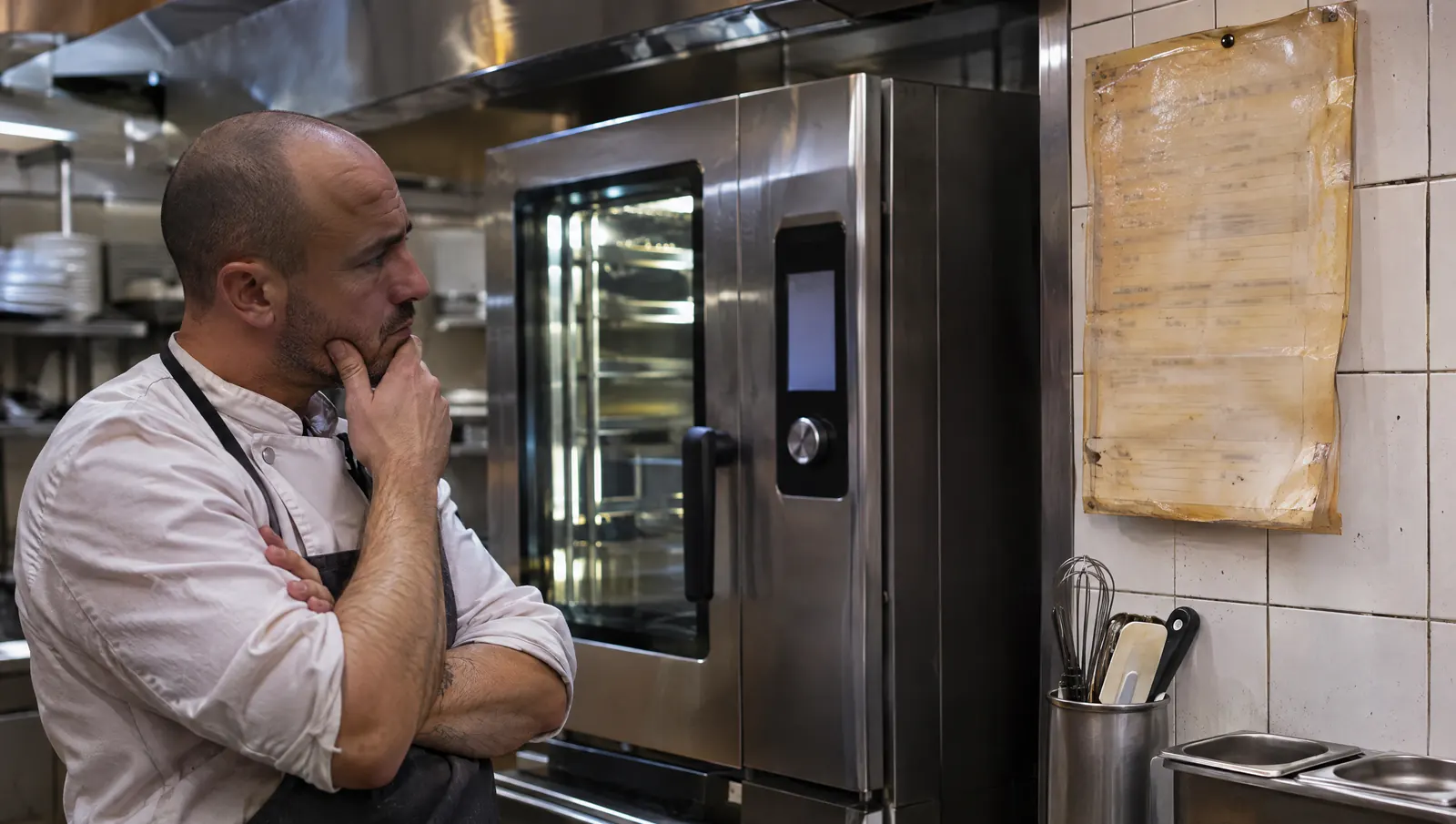
A missing procedure is visible: people look, find nothing, and ask. An outdated procedure is not: it looks valid, people follow it with confidence, and the mistake repeats every service. To prevent that, every sheet carries a date and an owner, gets reviewed as soon as the equipment, product or recipe changes, and old printed copies come down the same day.
Monday, 9:10 a.m., in front of the new oven
The new combi oven arrived on Saturday. Gwenaëlle, a cook, is getting the lasagne ready to reheat for lunch. Pinned next to the oven is a laminated sheet, yellowed by steam: "Reheating: 160°C, dry heat, 35 minutes. Check core temperature."
She sets the oven. Then she pauses. The control panel looks nothing like the old one. It offers a combi mode, a steam mode, a probe. The sheet describes an oven that no longer exists. Does 160°C on dry heat give the same result here? Is 35 minutes enough, or too much?
Gwenaëlle does the right thing: she inserts the probe, waits for the core temperature, and calls Albane, the head chef, who gets in at 10. But she could just as easily have followed the sheet without thinking. It is laminated, it is in the right place, it has always been right. That is exactly what makes it dangerous.
(Gwenaëlle, Albane and their kitchen are fictional.)
Why a wrong sheet misleads better than no sheet
A gap leads to a question
When there is no sheet, the person knows they do not know. They ask the chef or a colleague, or they check the binder. The gap is uncomfortable, and that discomfort is protective: it brings in a person who knows the answer.
An outdated sheet looks exactly like the truth
It is in the right place, in the right format, and it has been used hundreds of times. Nothing sets it apart from a correct sheet. The person who follows it is being disciplined: the procedure is what misled them.
The mistake repeats quietly
A gap causes hesitation, once. A wrong sheet causes the same mistake every service, for every person who reads it, until someone finally notices. The more disciplined the team, the more consistent the mistake.
New starters are the most exposed
Long-serving staff often know "that sheet is wrong" and quietly do it differently. The new hire, the seasonal worker, the Saturday temp read the sheet and apply it. They are the ones who follow instructions best, and the ones who pay for the outdated sheet.
Four changes that make a sheet go stale without warning
A procedure ages less with time than with what changes around it.
- Replaced equipment. A new oven, blast chiller or slicer means different settings, times, cleaning and sometimes safety steps. Gwenaëlle's sheet is a case in point.
- A different supplier or product. The new veal stock has a different composition, the new baker's sandwich loaf contains sesame. The recipe card and the allergen sheet are wrong overnight.
- A modified recipe. The chef swaps cream for coconut milk, adds a hazelnut crumble, changes a cooking method. If the sheet is not updated, front of house answers guests with the old recipe.
- A new cleaning product. Different dilution, contact time, protective equipment, rinsing. An outdated cleaning sheet can damage equipment, leave residue or put an employee at risk.
On top of these four come changes in how work is organized: a station removed, a shift moved, a task shifted from the dish pit to closing. Nobody thinks to reread the sheet for the station that moved.
How to make sure no sheet goes stale quietly
- A date and an owner on every sheet. The date of the last approval and the name of the person responsible appear on the sheet, on screen and on the printed copy. A sheet with no date cannot tell you whether it is still true.
- Write down what the sheet depends on. One line at the bottom: "Depends on: hot kitchen combi oven, veal stock from our usual supplier." That line tells you what to reread when something changes.
- Review at every change, before it goes into service. The day the oven arrives, reread the sheets that mention it. The day a supplier changes, reread the recipe cards and allergen sheets for their products. It is the change that triggers the review.
- Keep a scheduled review as a safety net. At every menu change, and at least once a year, go through all the sheets to catch what slipped through.
- Let the team flag problems. The first person to see the gap is almost always the one doing the task. They need to be able to say "this sheet is wrong" without waiting for the right moment, as we describe in a wrong step in a checklist: flag it, fix it, for everyone.
- Take old printed versions down the same day. As long as the old one is still on the wall, that is the one people will follow. Walk round the stations, the binder and the plastic sleeves, and archive one copy of the old version, with its validity period, outside the kitchen.
Which change, which sheets to review
| Change | Sheets to review | Who handles it | When |
|---|---|---|---|
| Replaced equipment | Use, cooking, cleaning, equipment safety | Chef or maintenance lead | Before first use in service |
| New supplier or product | Recipe cards, allergens, goods-in, storage | Chef and quality lead | Before the first delivery is used |
| Modified recipe | Recipe card, allergens, prep, front-of-house briefing | Chef | Before the first service with the new recipe |
| New cleaning product | Cleaning plan, dilution, protective equipment, rinsing | Hygiene lead | Before the first clean with the product |
| Reorganized work | Sheets for the station concerned, opening and closing checklists | Site manager | The week of the change |
| No change noticed | Every sheet at the site | Each sheet's owner | At every menu change, and at least once a year |
The last row is the safety net. The first five do most of the work, because they tie the review to the moment a sheet is most likely to become wrong.
Common mistakes
- Reviewing procedures "when there's time". There rarely is, and the new oven is already in service.
- Adding a date without an owner. You know the sheet is old, not who should update it.
- Updating the tablet and forgetting the wall. The laminated copy always wins, because it is right there.
- Throwing out the old version without archiving it. On the day of an inspection or an incident, you need to know what was required on a given date. Who answers for it is covered in who is responsible if a procedure is wrong?.
- Keeping dead sheets "just in case". They get mixed up with the good ones and cast doubt on all of them. How to sort them is explained in how to replace procedure binders without creating a digital graveyard.
- Blaming the new hire for following the sheet. They did what they were asked; the sheet is what needed fixing.
What to measure
- The share of sheets in use that carry an approval date and an owner. The goal is all of them.
- The number of sheets dated before the last change of equipment, supplier or recipe that affects them. Each one is a sheet to review.
- The number of versions of the same procedure in circulation (screen, wall, binder). The right answer is one.
Where Tsuno and San fit in
In Tsuno, procedures and files are filed by site, and everyone only sees and edits what their role and sites allow. Opening, closing and prep checklists are built from templates and keep their history. Recipes have their recipe cards, and products and suppliers have their catalog. A gap someone spots can become a task assigned to the owner, or a message in the team channel. The full list is on the features page.
Tsuno San, the intelligent voice assistant for teams, gives access to these sheets within the person's permissions; San Voice is available in demo. San will never answer better than your sheets: if one is outdated, it will show it as it is. It cites its sources, so the person knows which sheet the answer comes from.
What a good tool should do on top of that, and what we are building: show the sheet's date next to the answer, link each sheet to the equipment, product or recipe it depends on, and flag the sheets to review when one of them changes. To see the assistant working on your own sheets, visit the Tsuno San page.
Further reading
For the big picture, read Tsuno San, the work companion for frontline teams. On how an assistant should sort its own mistakes, outdated information included, see an assistant that is wrong once in twenty: which mistakes are acceptable?. To keep a procedure alive over time, explain it once: how to make a standard live. And for allergens, where an outdated sheet is unforgiving, allergens: why no tool should answer from memory. To work out which tool should hold the current version of each sheet, see HACCP software, scheduling tool, assistant: where each one stops.
Key takeaways
A missing sheet brings in a person; an outdated one replaces them with a mistake that repeats. Date it, name an owner, review it at every change of equipment, product or recipe, and take the old copies down the same day.
Frequently asked questions
Why is an outdated procedure more dangerous than a missing one?
Because an absence gets noticed: the person looks, finds nothing, and asks. An outdated procedure looks valid. People follow it without a second thought, and the same mistake repeats every service without anyone seeing it.
What makes a restaurant procedure go out of date?
Almost always a change: replaced equipment, a different supplier or product, a modified recipe, a new cleaning product, a reorganized shift. The sheet stays the same while the kitchen moves on.
How often should restaurant procedures be reviewed?
First and foremost whenever equipment, a supplier, a recipe or a cleaning product changes. On top of that, a scheduled review, for example at every menu change and at least once a year, to catch what slipped through.
What should you do with old printed versions of a procedure?
Take them down the day the new version takes effect, from every wall, binder and station. Keep one archived copy of the old version, with its validity period, outside the kitchen.
What should a sheet show so people can tell whether it is current?
The date it was last approved, the name of its owner, and what it depends on: the equipment, product or supplier involved. If any of those has changed since that date, the sheet needs reviewing.
Keep reading
Hygiene and compliance
Who is responsible if a procedure is wrong?
The food business operator answers for food safety, even when a wrong procedure comes from a tool. Tools distribute, they don't author. Dated sign-off protects.

Hygiene and compliance
Allergens: why no tool should answer from memory
On allergens, no tool should answer from memory: it shows the dish's approved, dated sheet, or says it has none and refers you to the person in charge.

Hygiene and compliance
HACCP checks with busy hands: no more greasy pen
A useful temperature check is logged when you read the thermometer, not that evening from memory. Saying it aloud keeps the real time, the person and next steps.