
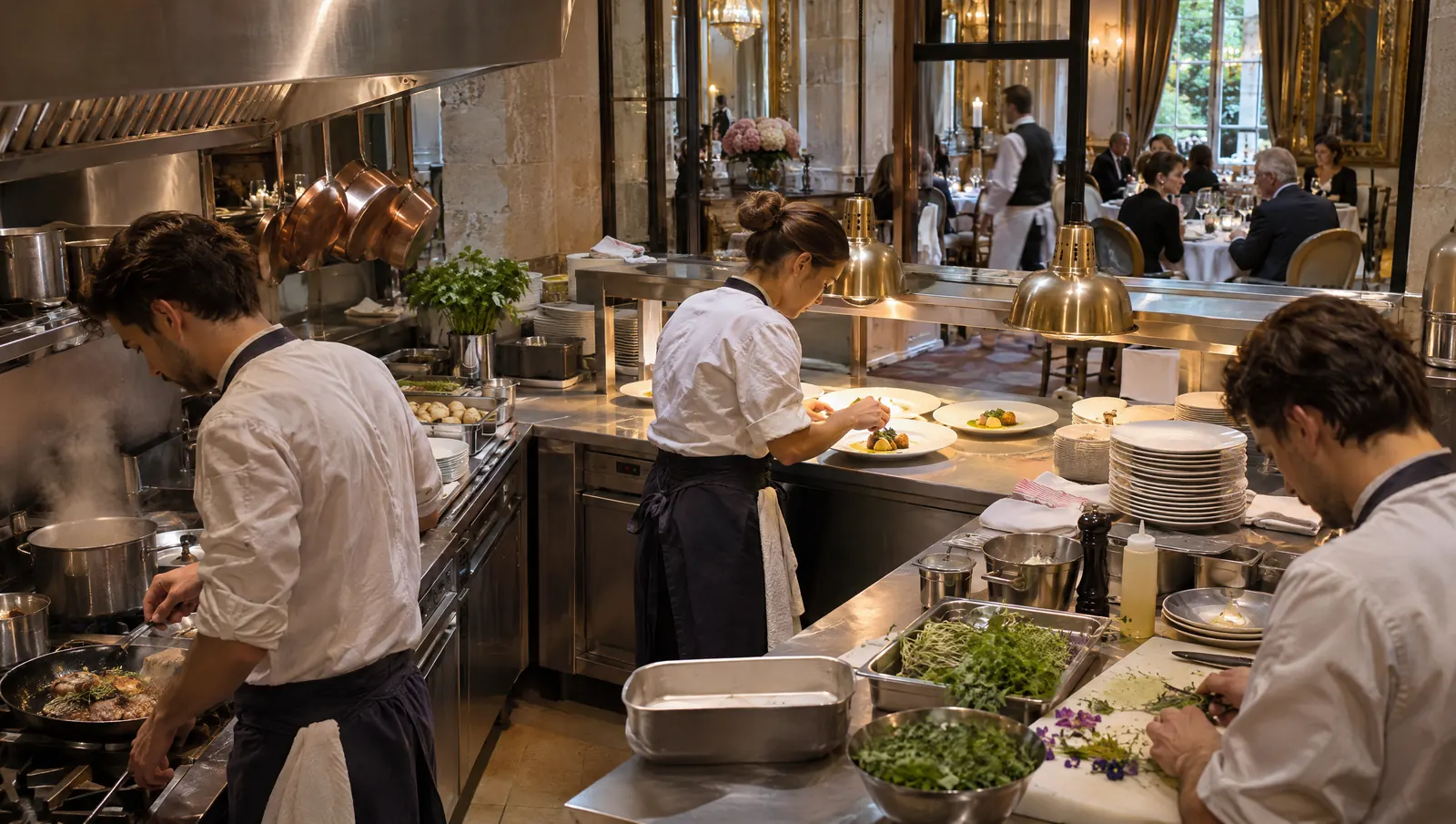
San by voice belongs in the back of house, where hands are full and only colleagues can hear: the storeroom, the walk-in for a short question, the dish station, prep, and the kitchen outside the rush. At the pass, on the floor, at the counter and in the office, it is screen only. During the rush, no voice, and the screen only if needed; in the locker room, you do not consult San at all. The line is drawn on your floor plan, and it moves with the clock.
Monday, 3:10 p.m., the floor plan on the pass
Lunch service is over. Elsa, the general manager, has printed a large copy of the floor plan and laid it on the pass with three markers: green, orange and red. Roger, the head chef, has a towel over his shoulder and not much time.
They start at the back. Storeroom: green, no debate. Walk-in: green, "but short, nobody chats in there." Dish station: green. At the pass, Roger hesitates, then picks up the orange: "This is where I do the talking." Dining room: orange. The locker room: Elsa has the red marker out before he finishes his sentence.
At the hot line, they stop. In the morning, it is green. At 8:30 p.m., it is red. Elsa draws two colors in the same box.
(Elsa, Roger and their restaurant are fictional.)
How the map gets drawn
To color an area, you ask three questions, then look at what the time of day changes.
Who can hear?
If a guest can hear the question, voice is out. If only colleagues are around, voice is possible, as long as the question is not about anyone in particular. Questions about your own hours or about a coworker go on screen, everywhere.
What are the hands doing, and is the task risky?
Wet, gloved or full hands argue for voice. A dangerous task (knife, slicer, corrosive product, fryer) argues for silence: finish the move, then ask.
Is there a written procedure for this station?
San only answers from what the restaurant has written. An area where nothing is written stays empty, even if you color it green. Before coloring it, check that the five questions people ask there have a written answer. We go into this in why voice alone is not enough.
The clock changes the color
The same hot line is calm at 10 a.m. and deafening at 8:30 p.m. The same open kitchen is a workshop at 11 a.m. and a stage at noon: a map without times is wrong for part of the day.
The walk-through, area by area
Green areas: where voice helps
The storeroom. You put away a delivery with your arms full, you look for a product. "What's left to put away?" is a storeroom question. Status: yes.
The walk-in. You go in carrying tubs and want to get out fast and shut the door. A short question, thought through before you walk in: yes. A long conversation with the door open: no. Walk-ins often have poor reception: if the answer does not come, step out and read it on screen. Status: yes, for a short question.
The dish station. Hands in water, machine open, and that is exactly when you wonder in which order it comes apart. Status: yes.
Prep. Mise en place, knife work, labeling tubs: hands are busy for hours and the same questions keep coming back ("What's my next task?"). Status: yes, except during knife or slicer work.
The kitchen outside the rush. Before and after service, the line is a station like any other: opening, cleaning, closing checklist. Status: yes.
Orange areas: screen only
The pass. This is where the chef calls orders and the brigade calls back. Someone talking to a machine muddles the calls, and what people need to know during service should be displayed, not asked for. Status: screen only.
The dining room. Guests wonder whether they are being listened to, and their conversations have no place within reach of a work microphone. Staff check the screen out of sight. Status: screen only.
The counter. Same logic as the dining room, only closer: the guest is three feet away. Check the screen where they cannot see it. Status: screen only.
The office. You are sitting down with free hands, dealing with schedules, time off, shift swaps and reports, or querying Tsuno from your usual AI assistant. Voice adds nothing, and these topics are not for saying out loud. Status: screen only.
Red areas, where voice stays off
The rush. While plates are going out, nobody talks to a tool. People talk to each other, read what is already at the pass, and a quick glance at the screen stays possible if needed. Noise does the rest; see kitchen noise and why voice is not always the answer. Status: no voice; screen only if needed.
The locker room. It is a place for breaks and privacy. In France, the CNIL, the French data protection authority, states in its guidance on video surveillance at work that cameras must not film break or rest areas or toilets. A voice assistant films nothing, but the same logic applies: a work tool that listens does not go where people change. A good rule: the device is picked up at the station and left there. Status: no, neither voice nor screen.
The full map, with what flips each area
| Area | Status | What changes the status | Why |
|---|---|---|---|
| Storeroom | Yes | Nothing, except a personal question | Arms full, colleagues only |
| Walk-in | Yes, short question | No reception: step out and read | Door to close, cold, gloves |
| Dish station | Yes | Handling a corrosive product | Wet hands, machine open |
| Prep | Yes | Knife or slicer work | Hands busy for hours, frequent questions |
| Kitchen outside the rush | Yes | The first tickets coming in | Opening, cleaning, closing |
| Rush | No voice; screen only if needed | The end of service | Noise, pace, calls |
| Pass | Screen only | Never voice | The chef calls, information must be displayed |
| Dining room | Screen only | Never voice | Image, guests within earshot |
| Counter | Screen only | Never voice | Guest three feet away |
| Office | Screen only | Never voice | Free hands, personal topics |
| Locker room | No | Never | A place for breaks and privacy |
This table sets out our usage principles. Each team adapts it to its own walls; the dining room, counter and locker room rows do not move.
The cases that do not fit in a box
The open kitchen
During service, a kitchen that opens onto the dining room counts as the dining room: guests can see and hear. It becomes a kitchen again before the doors open and after the last guests leave. In this kind of restaurant, the map really does have two colors per box.
The small place where everything touches
When the dish station is six feet from the counter, "who can hear?" beats the station. If a guest can hear from the dish station, the dish station turns orange during opening hours.
The threshold rule
Whatever the layout, one simple rule settles most doubts: once you step through the door to the dining room, you stop talking to San. The kitchen door is the easiest line for a new hire to remember, and the easiest for a manager to check.
Drawing your own restaurant's map
- Print the floor plan, even a rough sketch. One area per room or station, the pass included.
- Walk it with the head chef and a team member, after service, not during.
- Color each area: green for yes, orange for screen only, red for no voice.
- Write in each box what makes it change color, mostly the time of day.
- Check the content: for each green area, five questions people ask there, and their written answers.
- Post the map in the kitchen, near where people start their shift, and walk every new hire through it.
- Review it after two weeks, with what the team has noticed.
Common mistakes
- Coloring the map without the team. The chef knows where it gets loud, the dishwasher knows where the signal drops.
- Drawing a map without times. It will be right in the morning and wrong at night.
- Coloring an area green when nothing is written for it. Voice will mostly answer "I don't know" there.
- Keeping the earpiece on when walking onto the floor. A threshold rule let slide once soon stops being followed.
- Forgetting personal questions. Even in a green area, your hours and time off are checked on screen.
What to measure
- The number of voice questions per area and per time of day, over two weeks. A green area where nobody speaks should change color, or content.
- Questions asked in orange or red areas, as reported by the team. They show the map is misunderstood, or badly drawn.
- How often people step out of the walk-in to read on screen because no answer came.
Where Tsuno and San fit in
Tsuno San is the intelligent voice assistant for frontline teams, connected to the Tsuno environment: procedures, tasks, checklists, routine checks, equipment and site information. There is only one San, on screen and by voice, with the same rules in every area (see what San never does). Everything voice allows must remain doable on screen, for people who would rather not speak.
San Voice is available in demo; San Audio, the hands-free experience that would serve green areas best, is still being explored, like San 360. On the hardware side, we describe a small dedicated Android device and a light earpiece; each person opens their session with the site code and their PIN. In a demo, we start from your floor plan: where you prep, where you store, where you clean. Details are on the Tsuno San page, and you can request a demo in a few clicks.
Further reading
The comparison of the two modes, moment by moment, is in San on screen, San by voice: when to use which. To see what this saves a manager, read how much time a manager loses answering the same questions. On the legal side of a microphone at work, a microphone at work: what the law says in France. And for the full picture, the pillar page Tsuno San, the work companion for frontline teams.
Key takeaways
San by voice belongs behind the kitchen door, where hands are full and only colleagues can hear, outside the rush. Draw that line on your floor plan with your team, with the times of day, and keep the threshold rule.
Frequently asked questions
Where in a restaurant can staff use a voice assistant?
In the back, where hands are full and only colleagues can hear: the storeroom, the walk-in for a short question, the dish station, prep, and the kitchen outside the rush. Elsewhere the screen is better, and in some areas you do not consult anything at all.
Why not use voice at the pass?
The pass is where the chef calls orders and the brigade calls back. A conversation with a tool there muddles the calls. Whatever people need to know during service should already be displayed at the pass, on screen.
What about an open kitchen?
During service, an open kitchen counts as the dining room: guests can see and hear. Staff check the screen discreetly. Voice remains an option before the doors open and after the last guests leave.
Can a voice assistant be used in a locker room or break room?
No. These are places for breaks and privacy. In France, the CNIL states that cameras must not film employees' break areas or toilets, and the same logic applies to a work tool that listens. The device is picked up at the station and left there.
How do I decide where voice is allowed in my restaurant?
Print the floor plan, walk it with the head chef and a team member, and color each area with one of three statuses: yes, screen only, no voice. Note what makes each area change color, mostly the time of day, then post the plan and review it after two weeks.
Is San Voice available?
San Voice, the voice interaction, is available in demo. San Audio, the hands-free experience, and San 360 are under exploration and testing. Using San on screen does not depend on those tracks.
Keep reading
AI and tools
San on screen, San by voice: when to use which
Voice for a short question with your hands full, back of house. The screen to read, check, ask about yourself or work the floor. A guide, moment by moment.
AI and tools
General voice assistant or a companion that knows your workplace?
For a timer, a consumer voice assistant is enough. For your recipes, permissions and team, you need a work companion. An 8-point comparison.
AI and tools
How to test a voice assistant in a kitchen
Thirty real questions from your team, under the hood and in the quiet, several voices, allergen traps, dictated numbers, then two weeks and two months of use.