

Tsuno San knows what your site has put into Tsuno: your procedures, tasks, checklists, logs, equipment and site information. It knows it within the access rights of the person speaking to it, and only within those rights. Whatever is not written anywhere in Tsuno, it does not know and does not guess: it says so. And there are things it does not know about you because it should not know them.
Wednesday, 3:10 pm, between lunch and dinner
Sana has been a commis for three weeks. The kitchen is quiet and she is tidying the walk-in. She asks San: "What's left before tonight?" San gives her the two tasks she still has, as Gaston, the sous-chef, assigned them that morning.
Then: "How much degreaser for the hood?" The site's own sheet comes up, with its steps.
Third question: "The opened smoked salmon, can we freeze it?" San replies that it has no sheet on that point and suggests she asks Ludovic, the head chef. She does. That evening, Ludovic writes the rule into Tsuno. The next day, the question has an answer.
(Scene and characters are fictional.)
Where do San's answers come from?
From what your site has written
San has no knowledge of its own about your restaurant. It is connected to the Tsuno environment the team already uses. When Sana asks about a dilution, San does not produce something that sounds like a cleaning procedure: it looks for the one your site actually wrote.
That is the difference with a general-purpose assistant, which can talk about anything but knows nothing about your hood, your degreaser or your delivery times. We explain why in why a general AI does not know your restaurant.
For this site, and no other
Data in Tsuno is kept separate. One brand never sees another, and a site's shared tablet only sees its own location. In a group of several restaurants, the procedure San gives Sana is the one her site has filed in Tsuno, not the one from the restaurant down the road.
Within the rights of the person speaking
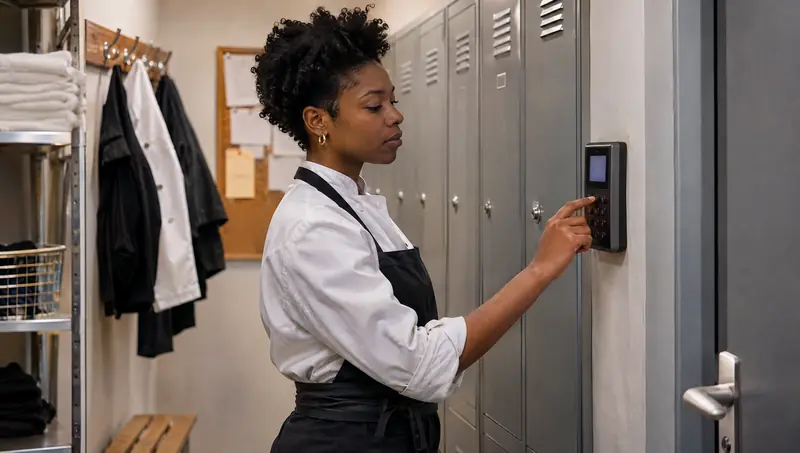
Each person opens their session with the site code and their PIN. So San knows who is talking and stays within that person's rights: Sana cannot use San to open a screen reserved for managers. We cover this principle in give your AI the same rights as you, no more.
What exactly does San know?
Here is what San can find, provided the site has put it into Tsuno.
| Type of information | Where it comes from | What San does with it |
|---|---|---|
| Procedure (cleaning, dilution, technique) | Written and approved by the site, filed by location | Shows it with its steps; if it is missing, says so |
| Tasks | Assigned in Tsuno by a manager, with a due time | Gives the next one, and what is left |
| Checklist (opening, closing, prep) | The site's templates, completed on the tablet | Says what is done and what is left, in order |
| Logs and checks | Entered by the team, per piece of equipment, with thresholds | Walks the person through the check; every entry is confirmed |
| Equipment | Listed by the site in Tsuno | Says where it is or what it is for, if that is written |
| Site information | Written by the site (who to call, times) | Gives it if it is written, otherwise says so |
| Recipe sheet, allergens | Technical sheet approved by the site | Shows the sheet instead of answering from memory |
| Anything written nowhere | Nobody put it into Tsuno | Says it does not know and points to a person |
Two rows deserve a word. For logs, San only prepares: the person confirms before anything is recorded, and the action is logged. For allergens, the design principle is that San shows the approved sheet, because a summary that is right nine times out of ten is not good enough. See "Is there sesame in it?" Why San shows the sheet instead of answering.
Why does San never guess?
A plausible answer is the most dangerous kind
If San filled the gaps with general knowledge, its answer to Sana about the salmon would have sounded right. It might well have been wrong for your restaurant, your products and your food safety plan. An answer that sounds good and is wrong goes unnoticed. An "I don't know" is visible straight away.
The gap is information
Every question with no sheet points to a hole in your procedures. Sana's question surfaced a rule everyone "knew" and nobody had written down. By that evening, it existed. That is the idea behind why an assistant must be able to say "I don't know".
An outdated sheet is still a risk
San does not know whether your sheet is still correct: it only knows the sheet exists. An old procedure shown with confidence can do more harm than a missing one. Reviewing sheets remains human work, and it is the subject of an outdated procedure is more dangerous than a missing one.
Not all facts are equal
In Tsuno, a fact never arrives without its origin. Tsuno tells six kinds of facts apart and never mixes them up.
- Recorded fact: logged without anyone typing it, such as a timestamp or an action Tsuno itself recorded.
- Declared fact: someone says it is done. Useful, but declared.
- Attached proof: a photo, a document, a delivery note tied to the fact.
- Observation: what a manager saw and noted, with its date, author and origin (seen first-hand, reported, written message).
- AI inference: a link suggested by the AI, flagged as such, never presented as a fact.
- No data: nothing was recorded, and Tsuno says so instead of filling the gap.
A Tsuno answer can show the facts and sources it relies on. And when it is fragile, it says so: missing data, conflicting data, facts declared without proof or filled in by the batch, too little history to call something a habit. The rule fits in one line: never "all good" when the reality is "no reliable data."
What San does not know about you, and should not
Some things are missing from Tsuno by oversight. Others are missing on principle.
- Your emotions, your stress, your mood. San does not analyse them. Under EU law, the AI Act (Regulation (EU) 2024/1689, Article 5) has banned systems that infer people's emotions in the workplace since 2 February 2025, except for medical or safety reasons. See AI and emotions at work: what has been banned since 2025.
- Your health, a pregnancy, a disability, your religion, your opinions. Tsuno refuses to record them about an employee (GDPR, Article 9) and offers to note dated, observed facts instead.
- Your motivation, your loyalty, your intentions. Tsuno does not infer them from your messages and does not predict who is about to quit.
- Your place on the monthly leaderboard. The app shows one, counting points earned in training, punctuality and completed tasks, to keep teams engaged. It is never passed to the assistant. San does not use it and does not assess anyone.
For the related question of who can read what you ask an assistant, see can your manager read your questions to an assistant?
Common mistakes
- Thinking San "learns" the restaurant by listening. It only knows what is written in Tsuno. A rule shouted across the pass and never written down does not exist for it.
- Connecting it to an empty binder. Without written procedures, San will often say it does not know. That is why rollout starts with the content, through La Mise au carré.
- Taking "I don't know" for a fault, when it points to a sheet that needs writing.
- Letting sheets go stale. San shows what is written; it does not review your procedures for you.
- Asking it for an opinion on a person. It will decline and offer the dated facts instead: training completed, tasks done, reviews to prepare.
What to measure
- The share of questions with no sheet, week after week. It should fall as the site writes down what is missing.
- The time between an unanswered question and the written sheet. In the scene above, one evening.
- The number of sheets nobody has reviewed in a long while, to go through with the site manager.
Where Tsuno and San fit in
Tsuno holds everything San can talk about: procedures and documents filed by location, tasks and due times, checklists, logs per piece of equipment, site information. San makes them available at the moment of the task, on screen or by voice, within each person's rights. The same rules apply from the assistant you already use (asking your restaurant questions from ChatGPT, Claude or Mistral), with capped reads so the connection cannot be used to pull out your data wholesale.
San Voice, the voice interaction, is available in demo. San Audio and San 360 are under exploration and testing. The Tsuno San page presents the assistant, and the Trust and data page details access rights, data separation and the six kinds of facts.
Further reading
To see where this insistence on sources comes from, read the story of San, born in a kitchen, not an office. For the rules around the assistant, see what San never does. And for the big picture, the pillar page Tsuno San, the work companion for frontline teams.
Key takeaways
San knows what your site has written in Tsuno, within the rights of the person speaking to it, and it says when it does not know. Your emotions, your health or your place on the monthly leaderboard stay out of its reach, by design.
Frequently asked questions
Where does Tsuno San get its answers?
From what the site has put into Tsuno: procedures, tasks, checklists, logs, equipment and site information. It does not go looking elsewhere for a procedure that is not written there.
Can San make up a procedure when it cannot find one?
No. When the sheet does not exist, San says so and points the person to a manager. A plausible but wrong answer would be more dangerous than admitting it does not know, especially on hygiene or allergens.
Can a commis see through San what their manager sees?
No. San acts within the rights of the person speaking to it. Each person opens their session with the site code and their PIN, and San only sees and does what that person can already see and do in Tsuno.
Does San know how employees feel, their health or their motivation?
No. San does not analyse emotions or stress, which the EU AI Act has banned in the workplace since 2 February 2025. Tsuno also refuses to record an employee's health, pregnancy, disability, religion or opinions.
Does San use the app's monthly leaderboard?
No. The monthly leaderboard counts points earned in training, punctuality and completed tasks, to keep teams engaged. It is never passed to the assistant, and San does not assess anyone.
How can I tell whether a Tsuno answer rests on solid facts?
Tsuno tells six kinds of facts apart: recorded, declared, attached proof, observation, AI inference flagged as such, and no data. An answer can show the facts and sources it used, and it flags when data is missing or conflicting.
Keep reading

AI and tools
12 questions to ask before connecting an AI to your business
Rights, confirmation, logs, data sent out, exclusions, leavers: 12 questions to ask a vendor before connecting your AI, and the answers to demand.

AI and tools
General voice assistant or a companion that knows your workplace?
For a timer, a consumer voice assistant is enough. For your recipes, permissions and team, you need a work companion. An 8-point comparison.
AI and tools
Give your AI the same rights as you, no more
An AI connected to your business should see and do what the person can already see and do, nothing more. That is what earns the trust of your teams.