
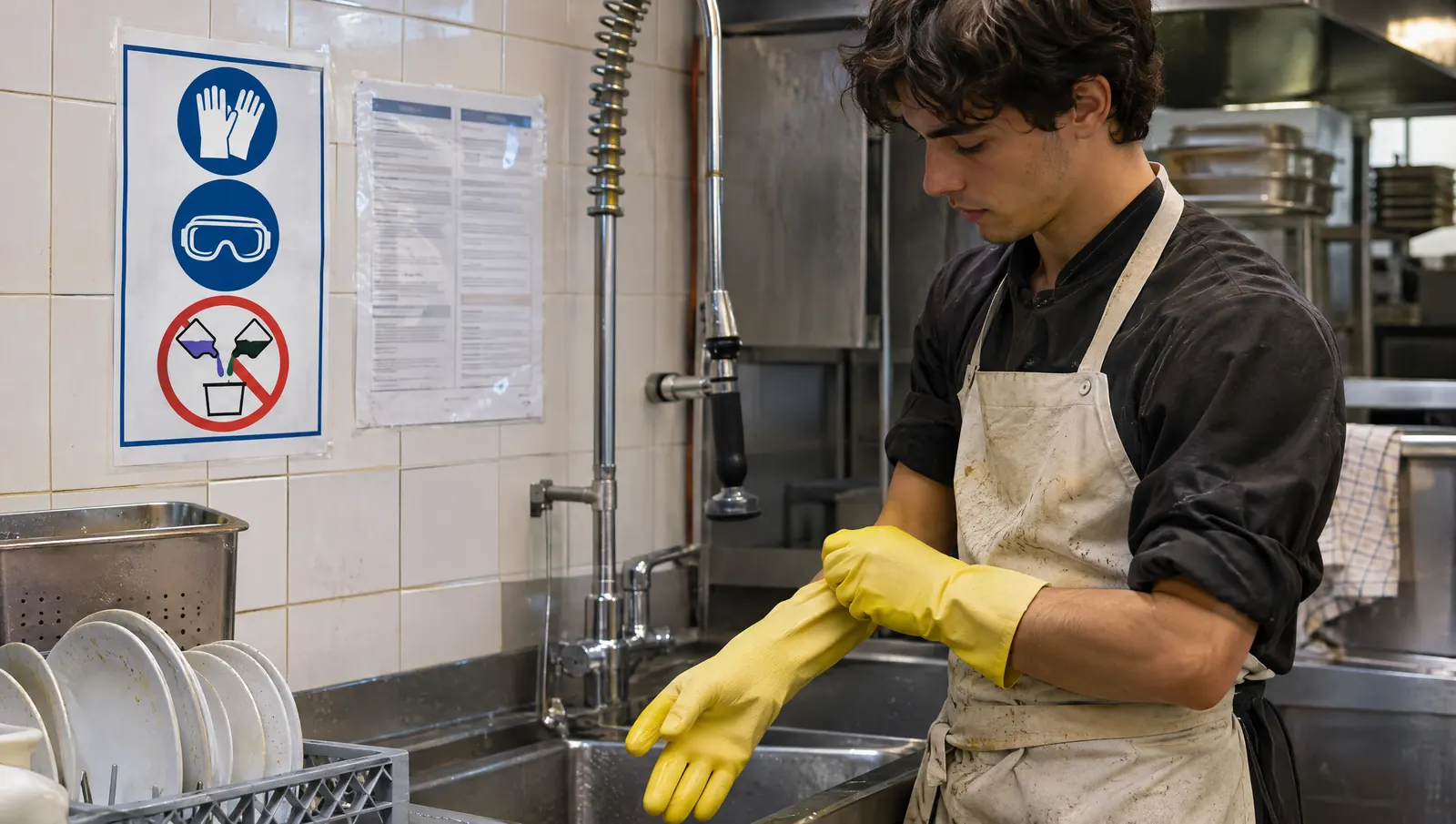
A translation, whether automatic or rushed, can betray exactly what matters in a safety instruction: a number, a unit, a negative. That is why the original instruction must stay on display next to the translation, why every critical translated instruction should be reviewed by someone who speaks the language and then dated, and why understanding is checked by watching people do the task. In France, the law adds a further point: these documents must exist in French, and translations are added alongside, never in place of the original.
Monday, 2:10 pm, in the dish area
Gilberte manages a staff canteen. She is switching to a new floor cleaning product. The instruction she has written fits on four lines: "Wear gloves and goggles. Dilute 20 ml of product in 5 litres of cold water. Leave for 10 minutes. Never mix with bleach."
Anh, the dishwasher, is Vietnamese and reads French with effort. Gilberte means well. She runs the sheet through a translation app on her phone, prints the Vietnamese version and tapes it to the wall in place of the old one.
The next day, Anh asks a colleague who reads both languages to check a sentence that looks odd to him. In the translated version, the amount of product and the amount of water no longer read the same way. And the sentence about bleach has become ambiguous: it is no longer clear whether it is a ban or a tip. Nobody got hurt. But the only version on the wall was the one nobody had checked, and the original, the one that counted, was gone. (Fictional people, workplace and product.)
Why safety instructions translate badly
Numbers and units
Numbers look universal, wrongly so. French uses a decimal comma where English uses a point. "1,5 l" can be misread as 15 litres if the comma gets lost. Millilitres, centilitres, "caps" and "scoops" do not always have a direct equivalent. A tool that rearranges the sentence can also attach the number to the wrong word.
Negatives and restrictions
"Do not", "never", "except", "only", "only after": these are the words that carry safety, and they are often the most fragile. A negative in the wrong place, a restriction dropped, and the instruction says the opposite or nothing at all. A long sentence with two negatives is a trap in any language.
In-house jargon
Every kitchen has its own words: "the chinois", "the pit", "a hotel pan", "into the blast chiller". A translation tool does not know them, or translates them literally. The dishwasher ends up with a sentence that looks correct and points to nothing real in the room.
The version that drifts
A translation done once stays on the wall. When the original changes (a new product, a new dilution), the translated version stays as it was. Two instructions now coexist, and the wrong one gets read, with all the risks of an outdated procedure.
What French law says
Article L1321-6 of the French Labour Code is short. The internal rules "are written in French" and "may be accompanied by translations into one or more foreign languages". The same applies to "any document setting out obligations for the employee or provisions that must be known to carry out the work". There is an exception for documents received from abroad or intended for foreign nationals. The text is on Légifrance, the official French legal database. If you operate elsewhere, check the rules in your own country.
For a dosing sheet or a cleaning procedure in France, the practical consequence is simple: the French version must exist, and it is the reference. A translation is allowed, and it is often a good idea when the team needs it. It goes alongside.
The method in seven steps
- Identify the critical instructions. Chemicals, allergens, temperatures and times, protective equipment, dangerous tasks, what to do after an accident. These are the ones that need a reviewed translation. The rest can wait.
- Simplify the original first. One action per sentence. Numbers as digits, always with their unit. The ban at the start of the sentence: "Never use bleach with this product." A clear original translates better.
- Translate, then have a speaker review it. The first draft can come from a tool. The review comes from someone who speaks the language and knows the work: a bilingual colleague, a trainer, a professional translator if the stakes justify it.
- Check the numbers in pairs. The manager and the reviewer go through every number, unit and negative together, line by line, comparing the original and the translation.
- Date and link the versions. The translation carries the date and version of the original it was made from. When the original changes, the translation comes down until it has been redone.
- Display them side by side, with pictograms. Original and translation on the same sheet or screen. The hazard pictograms from the product label (those of the EU CLP regulation) and a photo of the task or the expected result support the text.
- Check by doing. "Show me how you make up the bucket." The first time with the real product, with a supervisor watching. Then once more a few days later.
Type of instruction, translation risk, good practice
| Type of instruction | Translation risk | Good practice |
|---|---|---|
| Chemical dosing | Quantity or unit moved, decimal comma lost | Numbers and units checked in pairs, photo of the measuring cup |
| Do-not-mix warning | Negative weakened or reversed | Ban at the start of the sentence, hazard pictogram, human review |
| Temperature and time (cooling, cooking) | Threshold or duration attached to the wrong step | One value per line, with its unit, original alongside |
| Allergens | Ingredient name translated loosely | The approved site sheet is the reference, no free translation |
| Protective equipment | Unknown word for gloves or goggles | Mandatory-equipment pictograms and a photo of the item |
| Order of steps | Steps merged or swapped | Numbered steps, one action per line |
| In-house jargon | Word translated literally, meaningless | Use the everyday word or a photo |
| What to do after an accident | Long message, unreadable in an emergency | Three short actions, emergency number in digits, posted at eye level |
Common mistakes
- Replacing the original poster with the translation. The original must stay visible: it is the reference, and it is what the chef can point to.
- Trusting a translation because it "reads well". A fluent sentence can still be wrong.
- Translating a long, dense procedure as it is. Simplify first, translate second.
- Forgetting the translation when the original changes. An undated translation always ends up out of date.
- Relying on pictograms alone. They show the hazard, not the dose.
- Asking "Did you understand?" The answer will be yes. Ask them to show you.
What to measure
- The share of critical instructions that have, for each language spoken on the team, a reviewed and dated translation linked to the current original.
- The number of translations on display that are older than the latest change to the original. The target is none.
- The result of checking by doing: after an update, how many critical instructions are carried out correctly the first time.
Where Tsuno and San come in
In Tsuno, procedures and documents are filed by site, checklists keep their history, and the welcome booklet can be adapted to the role, the site and the language: it is drafted by AI and reviewed by you before it is handed over. The interface is available in French and English. A good tool should also link every translation to the version of the original it came from and flag when it is out of date.
For Tsuno San, the intelligent voice assistant for frontline teams, we are working on French, English, Arabic and Vietnamese. Translating sheets is not a feature we present as available. If it ever ships, it will follow the rules in this article: the original always visible, no translated safety instruction without human review, and for allergens, the site's approved sheet rather than an answer from memory. San only sees and does what the person can already see and do in Tsuno. The best way to judge is on your own sheets, in a demo.
Further reading
Languages on the team are covered in non-native speakers in the kitchen: understanding without shame. On versions that drift, read an outdated procedure is more dangerous than a missing one and who is responsible if a procedure is wrong. For allergens, see why no tool should answer from memory. And on accessibility more broadly, accents, stuttering, hearing loss: a voice tool for everyone, or for no one. The pillar page Tsuno San, the work companion for frontline teams describes the rest of the tool. For the team reading these instructions, see onboarding a multilingual team: a manager's guide and mixed languages in the kitchen, a reality software ignores.
Key takeaways
A translation helps people understand; the original stays the reference and must stay in view. For every critical instruction: a simple original, review by a speaker, numbers checked in pairs, a dated version, and a check by doing.
Frequently asked questions
Can you use machine translation for a safety instruction?
You can use it for a first draft. A translated safety instruction must then be reviewed by someone who speaks the language, checking every number, unit and negative line by line, and dated. The original instruction stays on display next to it.
Do workplace documents have to be in the local language?
It depends on the country. In France, article L1321-6 of the Labour Code requires the internal rules, and any document setting out obligations for employees or information they need to do their job, to be written in French. They may be accompanied by translations into one or more other languages.
What mistakes does machine translation make on instructions?
The most dangerous ones involve numbers and units (a decimal comma, millilitres turned into litres), negatives and restrictions (do not, never, except, only), and in-house jargon the tool does not know.
Can pictograms replace a translation?
No. They flag a hazard or required equipment and can be understood without reading, which is valuable. They do not give a dose, a contact time or the order of steps. They support the text, they do not replace it.
How do you check that a translated instruction was understood?
By having the person do it. Ask them to show you what they are going to do, with the real product and equipment, instead of asking whether they understood. The first time happens with a supervisor watching.
Does Tsuno San translate safety sheets?
Translating sheets is not a feature we present as available. We are working on French, English, Arabic and Vietnamese for San, with one rule: no translated safety instruction without human review, and the original always visible.
Keep reading
Hygiene and compliance
An outdated procedure is more dangerous than a missing one
A missing procedure makes people ask; an outdated one gets followed with confidence. Date every sheet, name an owner, take old printed copies down.
Hygiene and compliance
HACCP checks with busy hands: no more greasy pen
A useful temperature check is logged when you read the thermometer, not that evening from memory. Saying it aloud keeps the real time, the person and next steps.
Hygiene and compliance
Hygiene of shared equipment in restaurants
Tablets, probes, earpieces: anything that changes hands gets cleaned at a set time by a named person. Anything that touches the ear stays personal.