
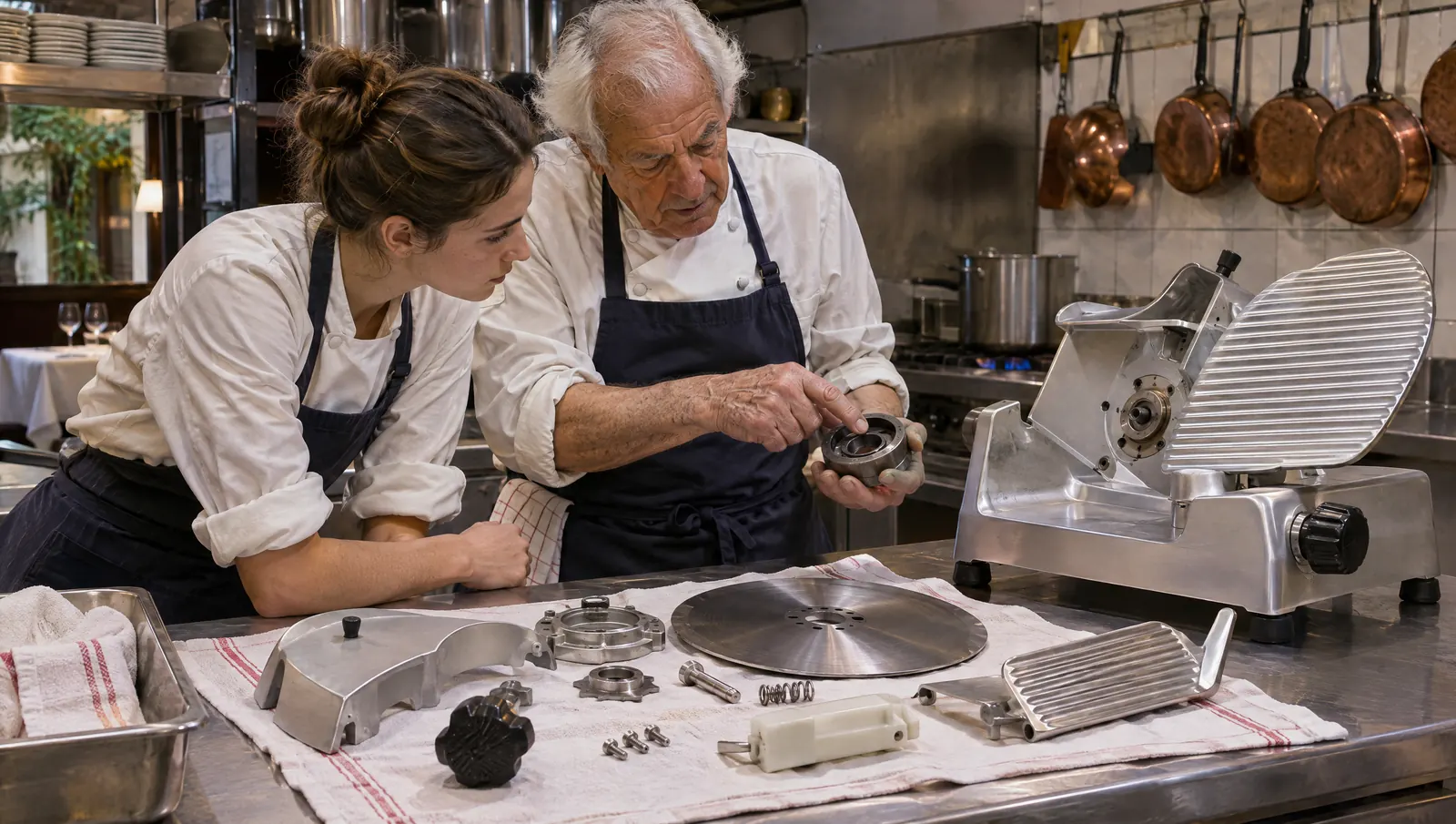
Taking the slicer apart, descaling the oven, the water valve hidden behind the dish station: in many kitchens these tasks are written down nowhere and live only in one veteran's head. To capture them, you do not ask that person to write. You have them do the task, talk it through and film it as they go, you transcribe it, someone else checks it by doing it, then you approve it, sign it with their name and date it. Filed at the station and named the way the team talks, the procedure can then be found with a simple question.
Saturday, 9:40 p.m., a leak under the dish station
A fitting gives way under the dishwasher in the middle of service. Water spreads across the tiles. Someone has to shut off the water to the dish station, and nobody knows where the valve is. Bernard knows: he has worked in this restaurant for twenty-eight years. But Bernard is on his day off. It takes forty minutes, a flashlight and a call to a former colleague to find the valve, behind a baseboard hatch under the back sink.
On Monday, Zoé, the head chef, sits down with Bernard and makes a list. The dish station valve. The full teardown of the slicer, which everyone wipes down but only he really takes apart. Descaling the combi oven, done twice a year and never once started by anyone else. All three rest on him alone. Zoé does not ask him to write anything. She asks him to show, and she puts the youngest commis on the team next to him.
(Scene and characters are fictional.)
Why this knowledge is never written down
People don't know what they know
The philosopher Michael Polanyi put it in The Tacit Dimension (1966): we can know more than we can tell. A veteran no longer thinks about the order in which he takes the slicer apart, or the quarter turn he gives so as not to force a part. What has become automatic no longer gets explained. You have to do it again to remember it.
It passes through the hands, not through sentences
"Unscrew it, take the blade out, clean it": the sentence is accurate and useless. What matters is where the hands go, the part you never let go of, the click that tells you it is seated. This knowledge used to pass from hand to hand at the station. With teams that turn over quickly, the next pair of hands is often gone.
Rare procedures are the most fragile
A daily task ends up known by everyone. A task done twice a year, or only when something breaks, is known by one person, and that is the one missing on the day it is needed.
Writing takes time, and sometimes pride
Writing is not a veteran cook's job, and he may fear that putting what he knows on paper makes him replaceable. It all comes down to how you go about it: the method stays his, recognized and signed with his name.
The signed method, in seven steps
Here is the method we recommend for capturing a task only one person knows. It takes about an hour per task, rarely more.
- Pick the right moment. Capture the descaling on the day it is due, the slicer teardown after a service, the valve during a quiet spell. A task shown out of context loses half its detail.
- Have them do it, not describe it. The veteran does the real task, at his own pace, as usual. Nobody interrupts except to ask a question.
- Record him talking while he works. A second person holds the phone and records his voice. He says what he is doing and why. The "careful here" and "otherwise it breaks" lines are the most valuable part of the recording.
- Film the hands, one step at a time. Short clips of a few seconds, one per step. A photo of every hard-to-find spot, with a landmark: "baseboard hatch, under the back sink, on the left".
- Transcribe into short steps. One step per line, an action verb first, the reason for the tricky points alongside. Safety first: unplug the slicer, close the thickness setting, wear cut-resistant gloves.
- Have someone who doesn't know check it. The young commis does the task alone, sheet in hand, in front of the veteran. Every hesitation reveals a missing step or a badly worded line. Fix it on the spot.
- Approve, sign, date. The head chef checks safety and consistency with the manufacturer's manual. The sheet carries the veteran's name as author of the method, the name of whoever approved it, the date and a review date.
The signed method does not replace the manufacturer's manual, which remains the reference for equipment safety. It adds what the manual does not say: where the valve is in your building, which order avoids forcing a part.
What the signature changes for the veteran
"Method: Bernard" at the top of the sheet is a written acknowledgment of twenty-eight years in the trade, visible to everyone who uses it. It also tells people who to ask, and who will review the sheet in six months.
The signature shows where the method comes from, without saying anything about Bernard's worth compared with anyone else: it is neither a score nor an assessment. It is also asked for, not imposed: a veteran who does not want his name on the sheet must be able to say no.
A veteran who passes on a task in front of a colleague who then does it is also doing what the French AFEST approach describes, training in the actual work situation: that is the framework behind Tsuno Compétences.
Which format for which task
Not every task needs the same medium.
| Task | Frequency | What to capture | Recommended format | Approved by | Review |
|---|---|---|---|---|---|
| Shutting off water to the dish station | When something breaks | Exact location, access | Photo with landmark, two lines | Head chef | After any building work |
| Slicer teardown | Weekly | Order, safety, fragile parts | Written steps and one short clip per step | Head chef | Every six months |
| Combi oven descaling | Twice a year | Program, product, duration, traps | Written steps, photo of the oven screen | Head chef, with the manual | With every new oven |
| Overnight cooking setting | Depending on the menu | Values, reason for adjustments | Dated recipe sheet | Head chef | With every menu change |
Making the procedure findable with a simple question
On the night of the leak, nobody would have opened a binder. Three rules make a sheet findable.
- Name it the way the team talks. Nobody searches for "dishwashing area water supply isolation". They search for "the dish station valve" or "turn off the water". The title uses the team's words, and the sheet mentions other ways of saying it.
- Link it to the equipment and the station. The teardown sheet lives with the slicer and the cold station, the descaling sheet with the combi oven. You find it where you need it.
- Keep it short. Ten lines can be read with wet hands. Three pages cannot be read in an emergency.
That is what makes a question at the station possible: "Where's the water valve for the dish station?" or "How do I take the slicer apart?", answered by the restaurant's own sheet, with its photo and its date.
Common mistakes
- Asking the veteran to write it alone, in the evening. He will have neither the time nor the inclination, and the text will skip the steps he no longer sees.
- Filming it all in one take. Nobody watches a twenty-minute video mid-service. Short clips, one per step, get used.
- Approving without a test run. A sheet reviewed on screen always looks complete. A sheet run by a beginner shows its gaps.
- Leaving out the reasons. "Don't tighten all the way" without "otherwise the seal cracks" will be forgotten in the first rush.
- Waiting until the veteran leaves. The last month of a notice period is the worst time for a handover: their mind is elsewhere and time is short. Capture rare tasks now, while they are still there.
What to measure
- The number of tasks only one person knows, listed with the team, and how many have an approved, dated sheet. The list should get shorter month by month.
- The beginner test: can someone who has never done the task succeed with the sheet alone, watched by its author?
- Calls to former or absent staff for information. Each one points to a missing sheet.
Where Tsuno and San fit in
In Tsuno, procedures and files are stored by site, and skills are approved and dated by a manager. The "can train others" level is earned through training in the actual work situation, which lets you recognize a veteran as the person who passes a task on. The skills matrix shows, site by site, who can do what, and therefore which tasks rest on a single person. The details are on the Features page. If your procedures sit in binders or in people's heads, La Mise au carré is how we structure them with you at the start.
Tsuno San makes these sheets available at the moment of the task. "How do I clean the slicer?" is one of the questions people ask it, and it answers by bringing up the business's own sheet (the voice exchange, San Voice, can be seen in a demo today). When the sheet is missing, it says so, which adds one more task to the list of those to capture.
Part of the method still needs tooling. Turning a veteran's recording into steps he can review, showing the method's author and review date on every sheet, reminding the person in charge when the review is due: that is what a good tool should do, and it is what we are working on. Reviewing and approving will stay human.
Further reading
For everything San does, read the pillar page Tsuno San, the work companion for frontline teams. Once the sheet is written, it has to stay right: see a wrong step in a checklist: flag it, fix it for everyone, and for someone returning after time off, back from leave: "what changed since my last shift?". To see what lost know-how costs, read restaurant turnover: the hidden cost of lost knowledge, and to pass skills on without wearing out your best people, train people without turning your best employee into a full-time trainer.
Key takeaways
The most fragile knowledge in a kitchen is what one veteran holds and the team rarely uses. You capture it by having him do it, talk it through and film it, then having a beginner run it, and the sheet then carries the name of the person who passed it on.
Frequently asked questions
How do you document know-how that only one employee has?
Have them do it, not describe it: capture the task at the real moment it is due, record their explanations while they work, film their hands step by step, then turn it into short written steps that they review and correct themselves.
Why can't a veteran cook just write down their procedures?
Because much of what they know has become automatic. They no longer think about the steps, the settings or the traps they avoid. Those details come back when they redo the task in front of someone who asks questions.
Should the veteran's name go on the procedure?
Yes, if they agree. Signing the method with their name, the date and the name of whoever approved it recognizes their expertise, tells people who to ask and sets who will review it. It is not an assessment of the person.
Is a video enough as a procedure?
Rarely. A video shows the movement but is hard to watch mid-service and cannot be searched. The right format combines short written steps, a photo or short clip per step, and the reasons behind the tricky points.
How do you find a rarely used procedure when you need it?
Name it the way the team talks about it, link it to the equipment concerned and file it at the station. With an assistant like Tsuno San, you can then ask for it with a simple question, and it shows the business's own sheet.
Does an in-house procedure replace the manufacturer's manual?
No. The manual remains the reference for equipment safety and maintenance. The in-house method adds what the manual does not say: where things are in your kitchen, the order that works on your model, the traps specific to your equipment.
Keep reading
Pass it on without repeating
A wrong step in a checklist: flag it, fix it, for everyone
A wrong step is flagged from the checklist itself, becomes a proposal the manager approves, then a dated new version the whole team receives.
Pass it on without repeating
Back from leave: “what changed since my last shift?”
Back from time off, you learn what changed in scraps or through a mistake. A good tool lists what affects your station, dated and sourced, and nothing else.

Pass it on without repeating
Old hands: the first allies of a knowledge-sharing tool
Veterans push back when a tool explains their own job to them. Make them authors and go-to people: signed methods, the right to correct, real recognition, time.