
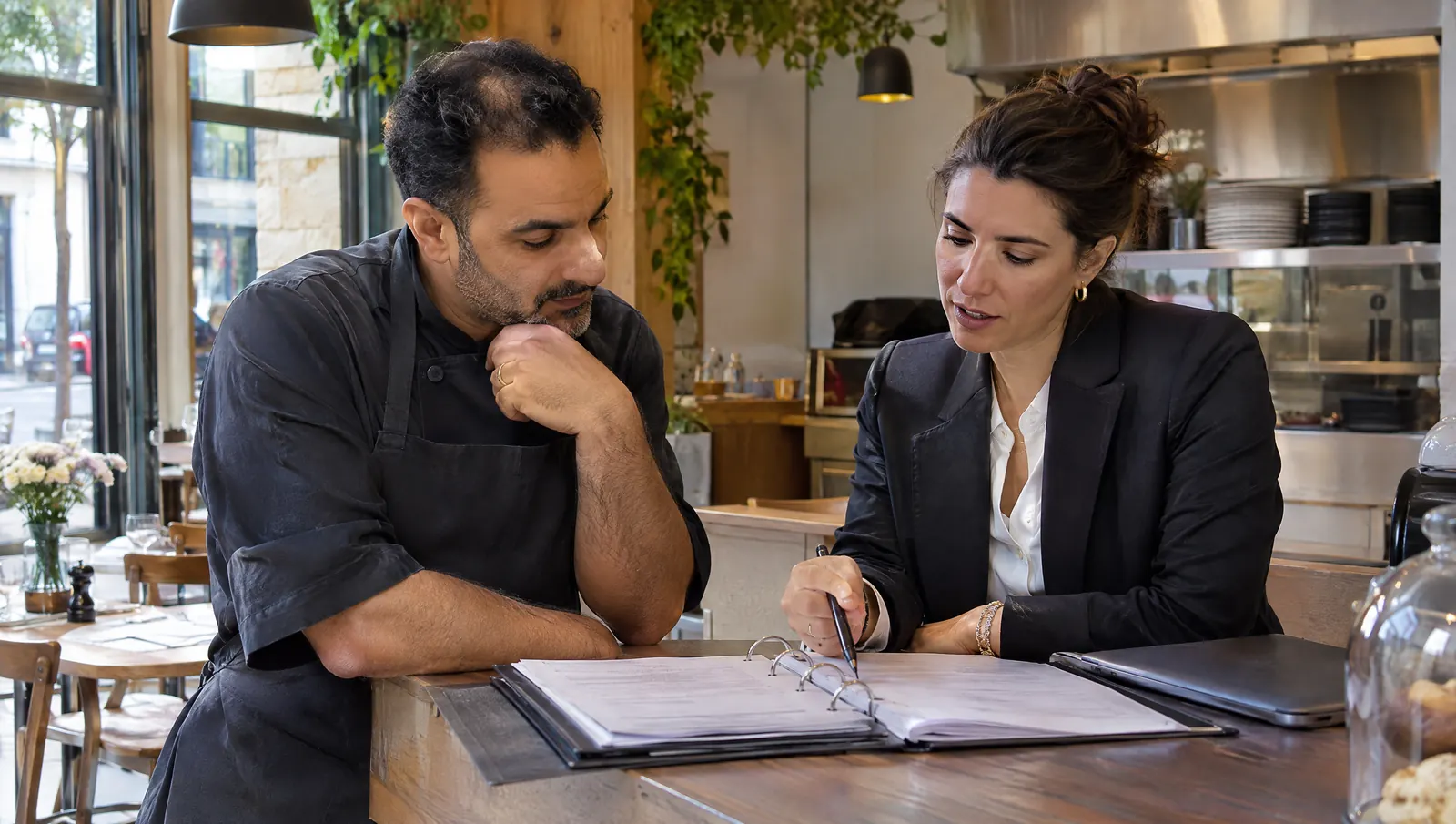
Head office can legitimately see whether its standards are applied: procedures in force, checklists done, audits, out-of-range readings, incidents aggregated by site. It has no business seeing the personal data of the franchisee's staff or the questions they ask, because the franchisee is their employer and answers for them. A good tool lets you set this line by brand, by location and by role, and the franchise agreement writes it down before anything is installed.
Tuesday, 3:10 pm, between services
Sylvain has run his franchised shop for four years. Aurore, the network's field manager, drops in for her quarterly visit. She puts a file on the counter: the rollout plan for the new shared tool.
Sylvain leafs through it, then stops. "So if I install this, you'll see when Gaëtan turns up late? His hours, his time off, what he asks the assistant?"
Aurore has no answer. She knows what she wants to see: whether the opening checklist was done, whether the walk-in stayed within range, whether the new recipe is being followed. Gaëtan's lateness is of no interest to her. But nothing in the file says what she would actually see.
Sylvain closes the file. "Standards, fine. My people, no."
(Sylvain, Aurore, Gaëtan and their shop are fictional.)
Why this is such a sensitive question in franchising
This article is not legal advice. It sets out the useful concepts, mostly under EU and French law; your agreement, your lawyer or your data protection officer have the final word.
The franchisee is an independent employer
The franchisee hires, organises the work, sets schedules and disciplines when needed. That is what makes them an independent business rather than an employee of the network. A head office that ran its franchisees' staff day to day would be taking a risk. In France, ruling on groups of companies, the Cour de cassation held that "co-employment" requires, absent a relationship of subordination, a "permanent interference" in the employer's economic and social management "leading to a total loss of autonomy" (Cass. soc., 25 November 2020, no. 18-13.769). The bar is high, but the spirit is clear: head office coordinates, it does not manage the franchisee's teams. Other countries have their own joint-employer rules; the instinct is the same.
Staff data belongs to the franchisee
The EU General Data Protection Regulation (GDPR, Regulation (EU) 2016/679) defines the controller as whoever determines the purposes and means of processing (Article 4(7)). For managing its own staff, that is usually the employer, so the franchisee. Seeing Gaëtan's hours is not one of head office's purposes.
Head office still has real reasons to look
The brand is shared. A food safety incident in one shop hurts all the others. The know-how passed on, the recipes and the food safety procedures are what the agreement is about. Wanting to check that they are applied is legitimate.
Distrust grows from tools that draw no lines
When software shows everything at every level, the franchisee assumes the worst, and is right to be wary. The useful debate is less about the shared tool itself than about two questions: who sees what, and who decided?
Controller or processor: who is who?
Three parties meet in a network that runs on shared software.
- The franchisee is the controller for the processing it does for its own business: payroll, schedules, time clock, staff training.
- Head office is the controller for the processing it does for its own purposes: running the network, audits, tracking standards. If it decides the purposes and means of the same processing together with the franchisee, both can be joint controllers (GDPR Article 26), and must then share out their obligations in an arrangement.
- The software vendor processes data on behalf of its customer and on its instructions: a processor under Article 4(8). Article 28 requires a contract governing that role, and says the processor only processes data on documented instructions from the controller.
The tricky part: who is the vendor's customer? Head office, each franchisee, or both? The answer changes who gives the instructions, and it has to be written into the contracts before it is turned into settings.
What head office can see, and what it should not
What head office can legitimately follow, site by site:
- the procedures and standards in force, with their version and date;
- which checklists were done or missed, without the person's name;
- audit results and their history;
- out-of-range temperature readings and the corrective action taken;
- incidents aggregated by type and period;
- local variations declared by the franchisee.
What it should not see:
- named schedules, hours, lateness, absences and leave of the franchisee's staff;
- reviews, meeting notes and dated facts recorded about a person;
- the questions an employee asks an assistant, typed or spoken;
- the hiring file, the employment contract, contact details.
The line is easy to state: head office looks at the site and the standard, never at the person. A missed reading is a fact about a procedure. Who missed it is a matter between the employee and their employer.
The who-sees-what matrix
This is what a good tool should let you configure. It is a starting grid to adapt to your agreement, not a legal rule.
| Information | Employee | Site manager | Franchisee | Head office |
|---|---|---|---|---|
| Own schedule, hours, training | Yes | Yes | Yes | No |
| Hours, lateness, absences of a named employee | Their own | Their site | Their sites | No |
| Questions asked to the assistant | Their own | No | No | No |
| Checklists done or missed, by site | Their station | Their site | Their sites | Yes, no names |
| Out-of-range readings and corrective action | Their site | Their site | Their sites | Yes |
| Audit results | No | Their site | Their sites | Yes |
| Incidents, by type | Their site | Their site | Their sites | Aggregated |
| Network procedures and local variations | Their station | Their site | Their sites | Yes |
Two cells call for an explicit decision: questions to the assistant (there is a case for not showing them even to the site manager) and incidents (head office needs the type and frequency, not the named account).
Network rules and local variations
Head office writes the non-negotiables: hygiene, allergens, signature recipes, the promise made to guests. The franchisee applies them and may adapt what the agreement leaves open: a local supplier, the order of prep, delivery times.
What matters is that the variation is written, dated and visible to head office. Declared in advance, it is a deliberate choice; found during an audit, it looks like drift and often ends in conflict. The three-level method (non-negotiable, adaptable, free) is set out in how to standardize multiple restaurants without making them identical.
The method: write the rule before installing the tool
- List head office's purposes. Why does it want to see? Standards, food safety, audits, network support. One line per purpose.
- For each purpose, pick the minimum data. Most of the time, one indicator per site is enough. A person's name is rarely needed.
- Write down who does what. Who is responsible for what, who instructs the vendor, in the franchise agreement or a dedicated schedule.
- Set access in the tool. By brand, by location, by role, starting from the matrix.
- Inform the franchisee's staff. Their employer does it: what is collected, why, who can access it.
- Review with every new feature. An AI assistant, a time clock, a new report: go back over the matrix before switching it on.
Common mistakes
- Giving head office "admin" access to every site, because it is convenient.
- Confusing supporting a network with managing a franchisee's teams.
- Leaving the agreement silent on data and relying on the tool's settings.
- Reporting incidents with a named account when the type and date are enough.
- Forgetting local variations: they exist, so they might as well be written down.
- Presenting the tool to the franchisee without showing the matrix. Sylvain's distrust fades in five minutes in front of a clear table.
What to measure
- The number of head office accounts with access to named data on franchisee staff. The right answer is zero, or a written exception.
- The share of local variations declared up front versus those found during audits.
- The time between an out-of-range reading and the corrective action, by site: the indicator head office really cares about.
Where Tsuno fits
Tsuno is organised like a business: a brand, its locations, their teams. Every read and every write is checked server side against the brand, the location and the role, not just the login. One brand never sees another. Network views (indicators, audits, reports, consolidated schedule) are for supervisors and above, limited to the sites assigned to them. The shared tablet only sees its own location, and a removed right applies immediately. For your teams' data, Tsuno acts as a processor, on your instructions.
The assistant, San or your usual AI, only sees and does what the person can already see and do, and the app's monthly leaderboard is never passed to it. San Voice, the voice interaction, is available as a demo.
How to split a franchise network into brands, locations and roles depends on your agreements: that is what we look at with you, on your own case, in a demo. Access rules are detailed on Trust and data, and the network features on Features.
Further reading
The overall framework for privacy at work is in AI, voice and privacy at work: the guide. On liability when a network procedure is wrong, read who is responsible if a procedure is wrong? For what an operator should look at each week, see Monday at 8am: what a multi-site operator really needs to see. The line between running a business and watching people is discussed in why management software can quickly feel like surveillance, and an assistant's access in give your AI the same rights as you, no more.
Key takeaways
In a franchise, head office looks at the site and the standard, and the franchisee manages the people. Write that line into the agreement, set it by brand, location and role, and show the franchisee the matrix before asking them to install anything.
Frequently asked questions
Can a franchisor see the personal data of its franchisees' employees?
As a rule, no. The franchisee is an independent employer: the schedules, hours, absences and named training records of its staff belong to its own business. Head office can track how standards are applied and see indicators aggregated by site, as the franchise agreement provides.
Who is the data controller in a franchise network under the GDPR?
It depends on who decides the purposes and means of each processing activity. For managing its own staff, the franchisee is usually the controller. Head office can be a controller for its own purposes, alone or jointly. The software vendor usually acts as a processor.
Can a franchisor require franchisees to use a specific software tool?
A franchise agreement can require common tools to apply the network's know-how. Requiring a tool does not give head office access to the personal data of the franchisee's staff. Who does what with the data must be written down and access set up to match.
What does head office need to see to enforce its standards?
The procedures in force and their version, which checklists were done by site, audit results, out-of-range readings and incidents aggregated by type. Not the name of the person who skipped a step.
Do questions a franchisee's employee asks an AI assistant go up to head office?
They should not. An individual question belongs to the person and their employer. A good tool gives head office, at most, topics aggregated by site, never the question of a named person.
Keep reading

Multiple restaurants
Anticipate rather than react: AI and restaurant planning
Anticipating means seeing what keeps repeating: missed logs, recurring breakdowns, uncovered shifts. AI lines up these dated signals; the owner decides.

Multiple restaurants
Several restaurants: what San changes for a group
Across a group, San gives the same sourced answer at every site, within each person's permissions. Local adaptation stays a human decision.

Multiple restaurants
How to delegate a restaurant without losing control
To delegate a restaurant, write down what the manager decides alone, what they flag and what escalates, then review facts rather than moods.